Teach Multiplication with Number Lines: A Visual Guide for 2nd Grade Parents
Discover how number lines transform multiplication from scary memorization into visual, hands-on learning for 2nd graders. Practical tips and interactive lessons inside!
Why Number Lines Make Multiplication Click for 2nd Graders
If your child freezes when they see multiplication problems, they're not alone. Many 2nd graders struggle with this new math concept because they're asked to memorize facts without truly understanding what multiplication means.
The good news? They don't need flashcards. They need to SEE what multiplication actually means. And that's exactly where number lines come in.
Number lines transform multiplication from abstract symbols into something visual and tangible. Instead of memorizing that 3×4=12, your child learns to see it as "three jumps of four" on a line. This visual approach connects to skills they already have (counting and adding) while building a rock-solid foundation for future math success.
In this guide, you'll discover exactly how to teach multiplication with number lines, why this method works so well for young learners, and practical activities you can do at home. Whether your child is a visual learner or just needs a different approach, the number line method might be the breakthrough you've been looking for.
What Is the Number Line Method for Multiplication?
The number line method teaches multiplication as a series of equal jumps along a line of numbers. Instead of memorizing isolated facts, children visualize the multiplication process from start to finish.
Here's how it works: To solve 3×4, your child starts at zero and makes three jumps, with each jump covering four spaces. They land on 4, then 8, then 12. The answer appears naturally as where they land!
Why this method is so powerful:
- It builds on what kids already know. Your child can already count and add. Number lines use these familiar skills to introduce something new.
- It shows the "why" behind the math. Kids see that 3×4 literally means "jump by 4 three times," not just a random fact to memorize.
- Equal jumps reinforce the core concept. "Each jump is the same every time! That's the pattern." This understanding of equal groups is the foundation of all multiplication.
- It creates mental pictures. Visual learners especially benefit because they can "see" the math happening.
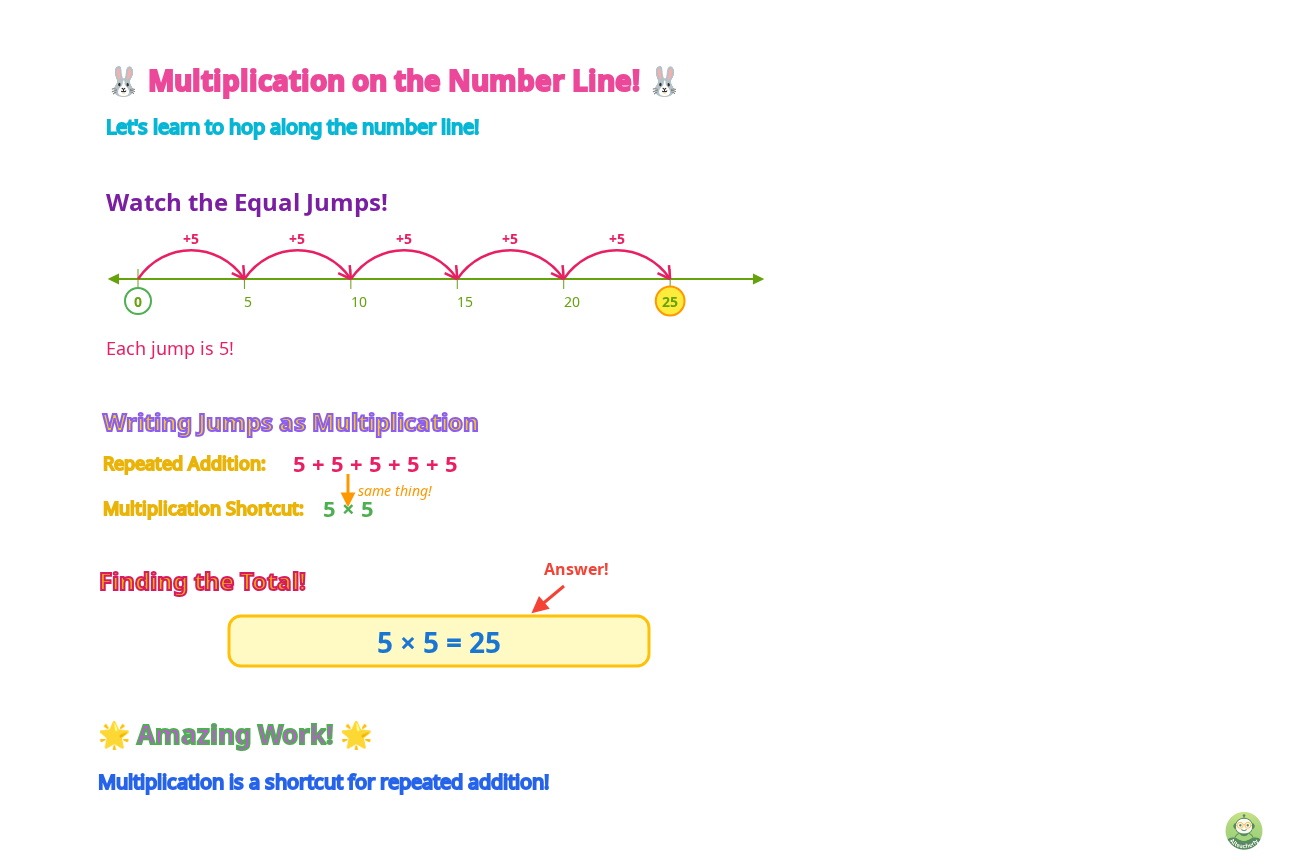
The interactive lesson below demonstrates exactly how this looks in practice on AI Teacherly:
This lesson overview shows how students learn to visualize multiplication through interactive number line activities, making abstract concepts concrete and engaging.
How Does Repeated Addition Connect to Multiplication?
Before your child can master multiplication, they need to understand one crucial bridge: repeated addition.
Repeated addition is simply adding the same number multiple times. For example:
- 4 + 4 + 4 = 12
This is the same as 3×4. "Multiplication is just a quicker way to add the same number over and over again."
Why this connection matters:
When children understand that 4+4+4 and 3×4 mean exactly the same thing, multiplication stops being scary. It becomes a shortcut they actually want to use!
On a number line, this connection becomes crystal clear:
- Start at 0
- Jump forward 4 spaces (now at 4)
- Jump forward 4 more spaces (now at 8)
- Jump forward 4 more spaces (land on 12)
Each jump represents adding 4 again. Three jumps of 4 equals 3×4.
The aha moment: "Instead of writing all that repeated addition, we can use multiplication! We just say: 3 times 4. And that means the same thing as 4+4+4!"
This conceptual understanding prevents confusion when multiplication gets more complex in later grades. Children who only memorize facts often struggle with word problems or multi-digit multiplication. But kids who understand the repeated addition connection can figure out problems even when they forget a specific fact.
Why 'Groups Of' Is the Key to Multiplication Understanding
Modern math education emphasizes understanding multiplication as "groups of." This language is intentional and incredibly helpful for young learners.
What "groups of" means:
- 3×4 reads as "3 groups of 4"
- 5×2 reads as "5 groups of 2"
- 6×3 reads as "6 groups of 3"
Why this language works:
When your child thinks "3 groups of 4," they can visualize:
- 3 baskets with 4 apples each
- 3 plates with 4 cookies each
- 3 jumps of 4 on a number line
This concrete imagery makes abstract numbers meaningful. Your child isn't just manipulating symbols; they're solving real problems about real groups.
The number line reinforces "groups of":
Every jump on the number line represents one group. For 3×4:
- Jump 1 = first group of 4 (land on 4)
- Jump 2 = second group of 4 (land on 8)
- Jump 3 = third group of 4 (land on 12)
Practice this language at home:
- "How many groups of 2 crackers can we make with 8 crackers?"
- "If we make 4 groups of 3 stickers, how many stickers is that?"
- "Let's count by 5s. Each count is one group of 5!"
Using "groups of" consistently helps your child develop the conceptual vocabulary they need for school success.
Try It: See Number Line Multiplication in Action
Seeing is believing, especially for 2nd graders learning multiplication! Interactive practice is where the learning truly sticks.
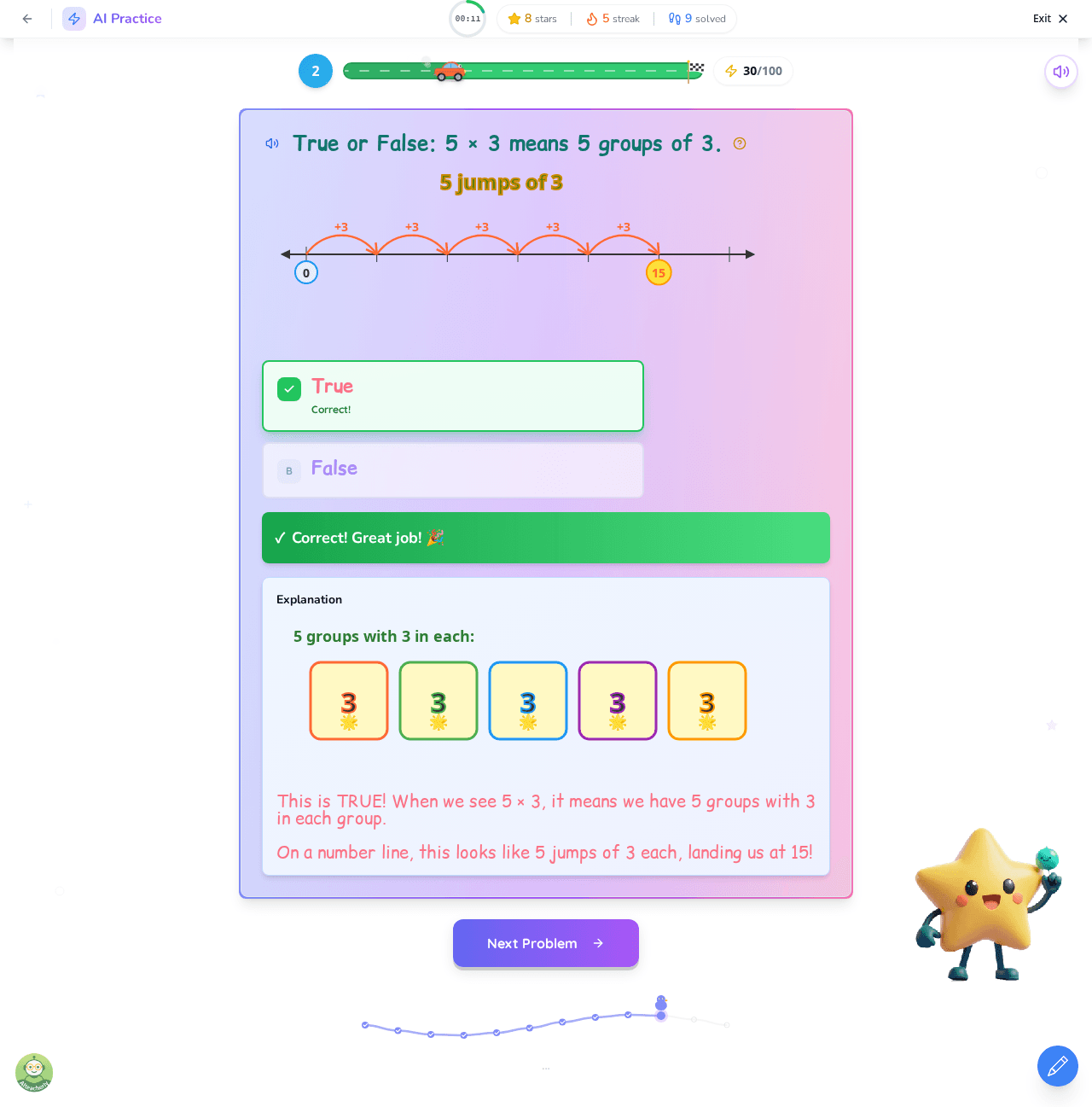
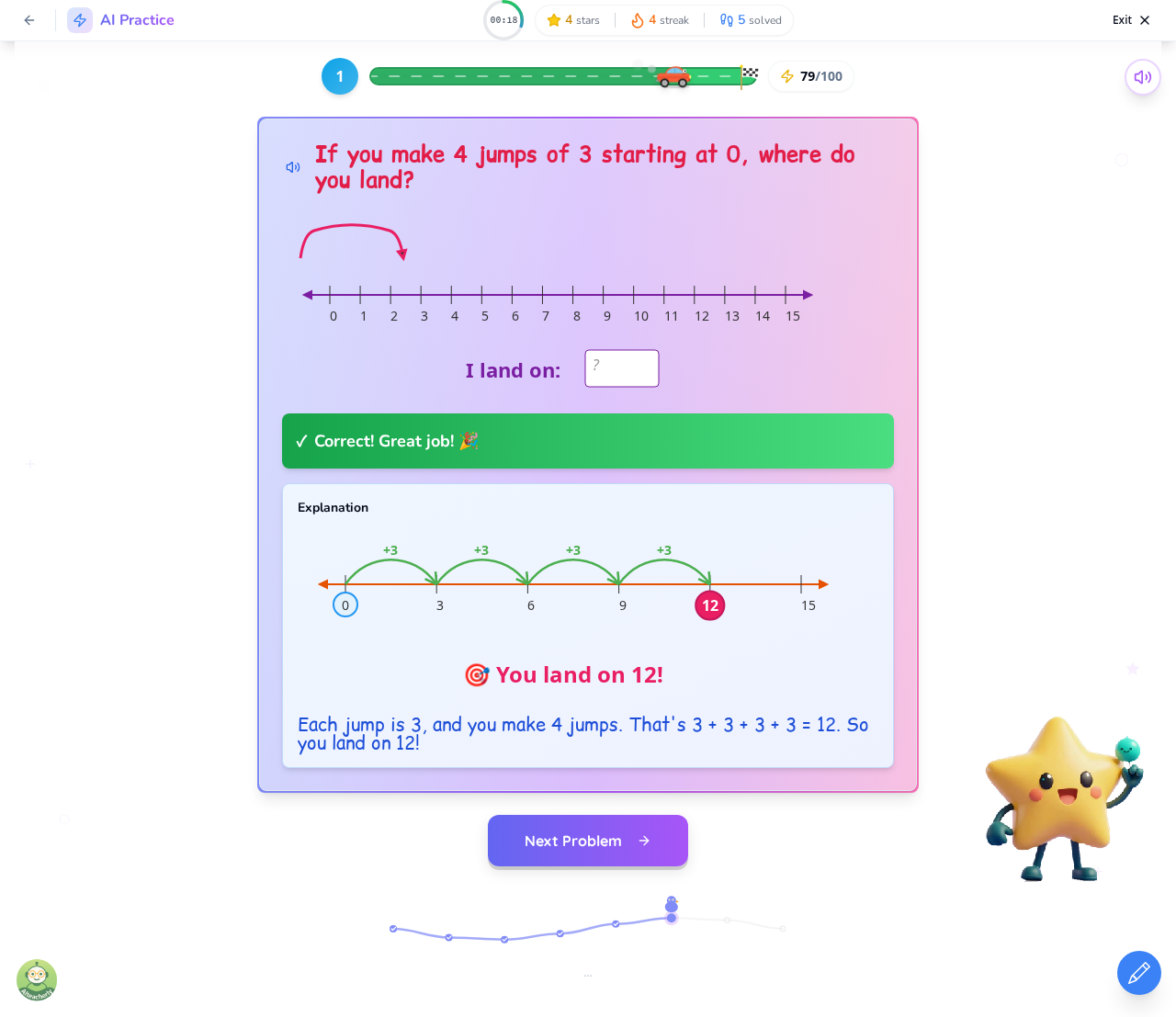
The interactive problem below shows exactly how number line multiplication works in practice:
In this activity, students see the jumps on the number line and calculate where they land. The visual representation makes the connection between the jumps and the multiplication product immediately clear.
What makes interactive practice so effective:
- Immediate feedback: Your child knows right away if they understood correctly, allowing them to self-correct in real time.
- Visual reinforcement: Every problem shows the jumps happening, reinforcing the concept with each attempt.
- Low-pressure learning: Digital practice feels like a game, reducing math anxiety and encouraging experimentation.
- Repetition without boredom: Varied problems keep practice fresh while building automatic recall.
What to look for as your child practices:
- Can they predict the landing spot? Before solving, ask "Where do you think you'll land?"
- Do they count the jumps correctly? The first number tells how many jumps.
- Are they recognizing the jump size? The second number tells how big each jump is.
- Can they explain their thinking? Verbalization deepens understanding.
On AI Teacherly, the Multiplication on the Number Line lesson guides students through this exact process with animated jumps, instant feedback, and progressively challenging problems.
3 Ways to Practice Number Line Multiplication at Home
You don't need fancy materials to reinforce number line multiplication at home. Here are three simple, effective activities:
1. The Floor Number Line
Use painter's tape to create a number line on your floor (0 to 20 works great). Have your child physically jump along it!
- Call out "3 groups of 2!" and watch them jump: 2, 4, 6.
- Ask "Where did you land?" and celebrate when they say "6!"
- Reverse it: "You landed on 15. You made 3 jumps. How big was each jump?"
The physical movement creates powerful muscle memory alongside mental understanding.
2. Sidewalk Chalk Number Lines
Take learning outside! Draw a long number line with sidewalk chalk and use toys or small objects as jumping markers.
- Race to solve problems: "First one to show 4×3 wins!"
- Create story problems: "The frog jumps 3 lily pads at a time. After 4 jumps, where is he?"
- Let your child create problems for you to solve.
3. Paper Number Lines with Stickers
Draw simple number lines on paper and use small stickers to mark the jumps.
- Use arc shapes to show each jump clearly.
- Color-code: different colors for different jump sizes.
- Keep completed number lines as a "multiplication journal" to review.
Pro tip: Keep sessions short (10-15 minutes) and fun. Enthusiasm is contagious, and positive math experiences build confidence!
Key Takeaways
- Number lines transform multiplication from memorization into visual understanding; kids see 3×4 as 'three jumps of four' rather than an isolated fact
- The repeated addition connection is crucial: showing that 4+4+4 equals 3×4 helps kids understand WHY multiplication works
- Using 'groups of' language (3 groups of 4) gives children concrete imagery that makes abstract numbers meaningful
- Visual and kinesthetic learners especially benefit from number line methods; if your child struggles with traditional approaches, this could be their breakthrough
- Physical practice (floor number lines, sidewalk chalk) creates muscle memory alongside mental understanding
- Short, positive practice sessions (10-15 minutes) build confidence and prevent math anxiety
- Interactive digital lessons on AI Teacherly provide immediate feedback and visual reinforcement that accelerates learning
Frequently Asked Questions
What is the number line method for teaching multiplication?
The number line method teaches multiplication as equal jumps. For 3×4, students start at zero and make 3 jumps of 4 spaces each, landing on 4, 8, then 12. This visual approach shows what multiplication means rather than requiring memorization.
How do I explain multiplication to my 2nd grader?
Use the 'groups of' language: 3×4 means '3 groups of 4.' Pair this with a number line showing 3 jumps of 4 spaces. Real-world examples like '3 plates with 4 cookies each' also help make the concept concrete and relatable.
Why do schools use number lines for multiplication?
Number lines build conceptual understanding before memorization. Research shows students who understand multiplication as repeated addition and equal groups perform better on word problems and retain knowledge longer than those who only memorize facts.
Is the number line method better than memorizing times tables?
Both are important! Number lines build understanding first, which makes memorization easier and more meaningful. Students who understand the 'why' behind multiplication can figure out forgotten facts and apply knowledge to new situations.
At what age should kids learn multiplication on a number line?
Most curricula introduce multiplication concepts in 2nd grade (ages 7-8), with number lines as a primary visual tool. Even younger children can explore skip counting on number lines, which builds the foundation for formal multiplication.
What if my child still struggles with multiplication after using number lines?
Try physical movement: create a floor number line and have them jump along it. Some children need kinesthetic (movement-based) learning. If struggles persist, check their addition fluency, as strong addition skills are prerequisite to multiplication success.
How can I practice number line multiplication at home?
Create floor number lines with tape for physical jumping, use sidewalk chalk outside, or draw paper number lines with stickers marking jumps. Keep sessions short (10-15 minutes), fun, and positive to build confidence alongside skills.
What does 'groups of' mean in multiplication?
When we say 3×4 is '3 groups of 4,' we mean 3 sets containing 4 items each. On a number line, this translates to 3 jumps that each cover 4 spaces. This language helps children visualize multiplication as combining equal groups.
Ready to see your child master multiplication through visual, interactive learning? The Multiplication on the Number Line lesson on AI Teacherly brings these concepts to life with animated jumps, instant feedback, and engaging practice. Try it free today and watch math anxiety transform into math confidence!