Teach Multiplication with Number Lines: A Visual Guide for 2nd Grade Parents
Multiplication doesn't have to mean flashcard stress. Discover how number lines transform abstract math into visible jumping adventures your 2nd grader can actually understand.
Why Number Lines Make Multiplication Click for 2nd Graders
When your child first encounters multiplication, it can feel like learning a foreign language. Suddenly, there are new symbols, times tables to memorize, and abstract concepts that seem to appear out of nowhere. But here's the good news: teach multiplication with number lines and you'll transform this intimidating subject into something your child can actually see and understand.
Number lines work because they take multiplication out of the abstract and make it physical. Instead of asking your 2nd grader to imagine what "4 × 3" means, they can watch (or draw!) four equal jumps of three on a line. Each jump lands on a number. Count where you end up, and you've got your answer.
This visual approach taps into how young minds naturally learn. Children at this age are concrete thinkers; they need to see things to understand them. The number line method bridges the gap between addition (which they already know) and multiplication (which feels new and scary). When your child sees that 3 + 3 + 3 + 3 is the same as making four jumps of 3, multiplication suddenly makes sense.
The best part? You don't need to be a math expert to teach this. If you can count along a line and make equal jumps, you can guide your child through multiplication with confidence.
What Is the Number Line Method for Multiplication?
The number line method teaches multiplication as repeated equal jumps on a horizontal line of numbers. Think of it like a frog hopping along lily pads, but instead of lily pads, we have numbers, and each hop covers the same distance.
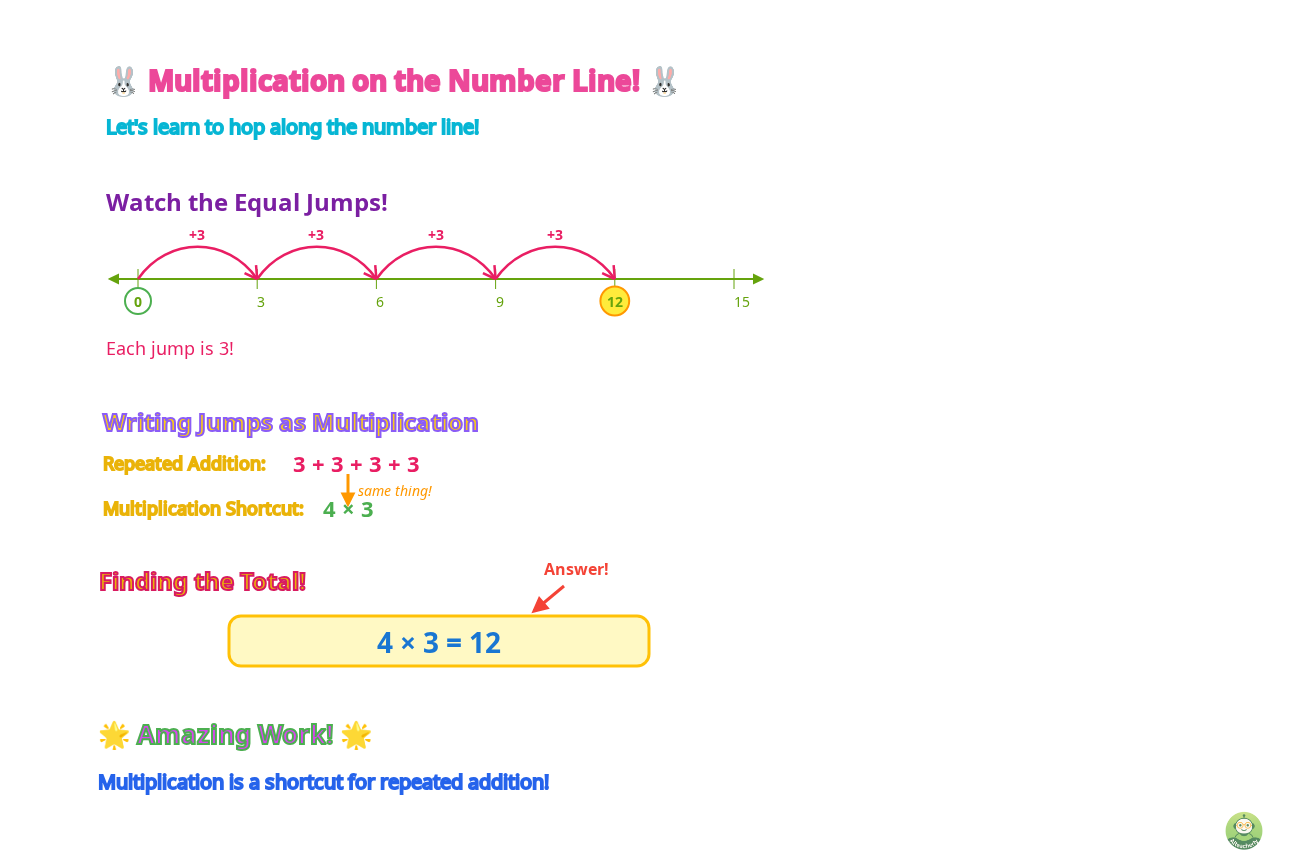
Here's how it works: To solve 4 × 3, your child starts at zero and makes 4 jumps, with each jump covering 3 spaces. Jump one lands on 3. Jump two lands on 6. Jump three lands on 9. Jump four lands on 12. The answer is where you land: 12.
Why equal jumps matter: The key concept is that every single jump must be the same size. This is what separates multiplication from random addition. If your child makes jumps of different sizes, they're just adding; when every jump is equal, that's multiplication.
This method connects directly to the "groups of" language used in classrooms. When teachers say "4 groups of 3," students can visualize 4 equal jumps of 3 on the number line. The abstract becomes concrete.
The number line method is also how most 2nd grade curricula introduce multiplication before moving to memorization. By learning this way first, your child builds genuine number sense rather than just memorizing facts they don't understand. This foundation makes later math concepts much easier to grasp.
How Does Repeated Addition Connect to Multiplication?
If your child already knows addition, they already know the foundation of multiplication. That's the secret teachers use, and you can use it too.
Multiplication is simply a shortcut for repeated addition. When we write 5 × 2, we're really saying "add 2 five times" or 2 + 2 + 2 + 2 + 2. Writing out all that addition takes time, so mathematicians created multiplication as a faster way to express the same idea.
On a number line, this connection becomes crystal clear:
- Start at 0
- Each jump represents adding the same number
- The number of jumps tells you how many times you're adding
- Where you land is both the sum of all that addition AND the product of multiplication
Here's a conversation you might have with your child:
"Let's add 3 + 3 + 3 + 3. Can you count on the number line?" "3, 6, 9, 12!" "Great! You just added 3 four times. In multiplication, we write that as 4 × 3 = 12. It means the same thing, just faster to write!"
This "aha moment" is powerful. When children see that multiplication is just a quicker way to do something they already know, the fear melts away. They're not learning something completely new; they're learning a shortcut for something familiar.
Research shows that students who understand this connection before memorizing times tables develop stronger mathematical reasoning skills that help them throughout their education.
Step-by-Step: Teaching Your Child to 'Jump' Through Multiplication
Ready to try the number line method at home? Follow these simple steps to introduce your child to multiplication through jumping:
Step 1: Draw Your Number Line Create a horizontal line with evenly spaced numbers from 0 to 20 (or higher as needed). You can draw this on paper, use tape on the floor with number cards, or even chalk on the sidewalk for an outdoor activity.
Step 2: Introduce the Jump Start with a simple problem like 3 × 2 (3 jumps of 2). Say: "We're going to make 3 jumps, and each jump goes 2 spaces. Let's see where we land!"
Step 3: Make Equal Jumps Together Place a finger (or toy figure) at 0. Make the first jump to 2, saying "Jump one!" Make the second jump to 4, saying "Jump two!" Make the third jump to 6, saying "Jump three!" Celebrate landing on 6.
Step 4: Connect to the Math Sentence Now write it out: "3 jumps of 2 equals 6. We write this as 3 × 2 = 6."
Step 5: Let Them Try Give your child a new problem and let them make the jumps independently. Guide them with questions like "How big is each jump?" and "How many jumps will you make?"
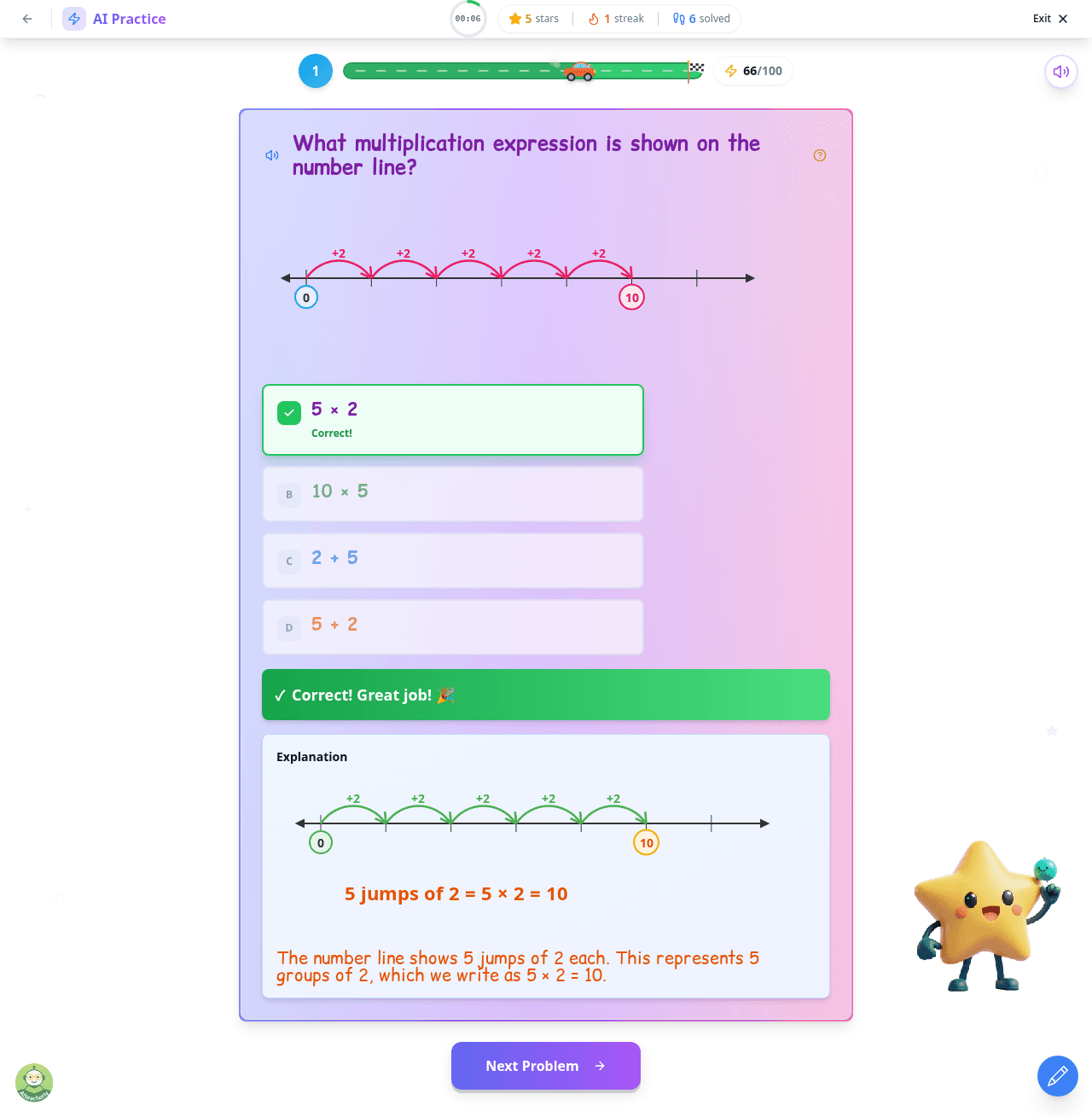
The interactive problem below shows exactly how this jumping method works in practice.
Pro tip: Use the phrase "jumps of" consistently. "4 jumps of 5" is clearer to young children than "4 times 5" or "4 multiplied by 5" when they're first learning.
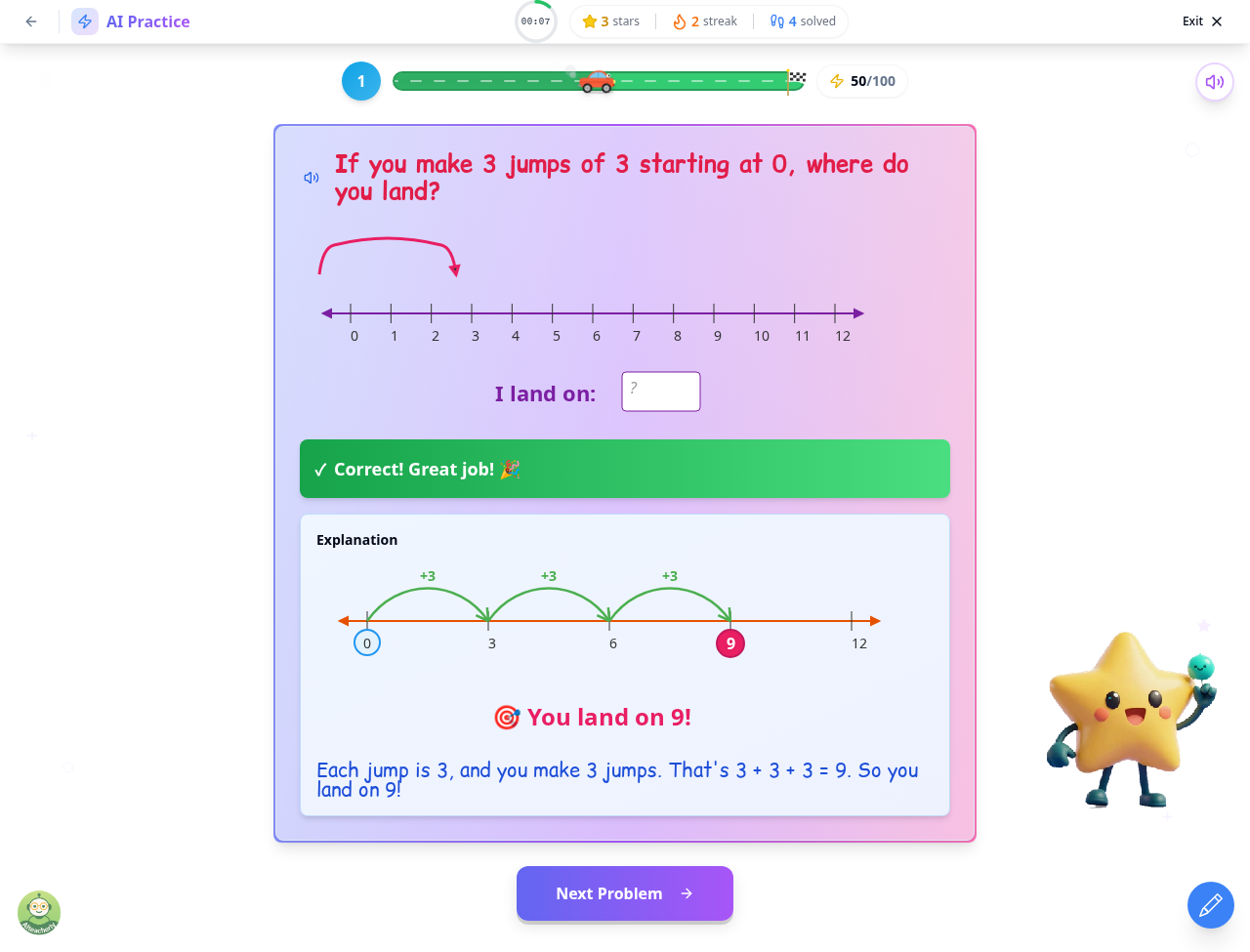
See Number Line Multiplication in Action
Seeing is believing, especially for visual learners. When children watch jumps happen on a number line, the abstract symbols of multiplication transform into something they can trace with their finger and count with their eyes.
On AI Teacherly, the Multiplication on the Number Line lesson brings this concept to life with interactive animations. Students don't just look at static pictures; they see the jumps happen in real-time and then practice making their own.
Here's what the full interactive lesson looks like on AI Teacherly:
The lesson starts by showing how repeated addition (like 3 + 3 + 3 + 3) becomes tedious to write. Then it introduces multiplication as the "faster way" to express the same idea. Students watch animated jumps on the number line, hear the script explain each step, and then try problems themselves.
What makes interactive practice powerful:
- Immediate feedback: Students know right away if their answer is correct
- Multiple problem types: MCQs, fill-in-the-blank, and selection questions keep practice engaging
- Visual consistency: Every problem reinforces the same jumping visual, building pattern recognition
- Self-paced learning: Children can take their time without feeling rushed
This combination of visual demonstration and hands-on practice is exactly what research says works best for teaching multiplication to young learners. The lesson builds understanding before asking for memorization, creating a foundation that makes times tables meaningful rather than arbitrary.
Simple Activities to Practice Number Line Multiplication at Home
You don't need fancy materials to practice number line multiplication. Here are activities you can do today with things you already have:
Floor Number Line (ages 6-8) Use painter's tape to create a number line on your floor. Write numbers on index cards and tape them at intervals. Have your child physically jump along the line while you call out multiplication problems. "Show me 3 jumps of 4!" This full-body activity helps kinesthetic learners internalize the concept.
Sidewalk Chalk Math (outdoor activity) Draw a long number line on your driveway or sidewalk. Let your child use chalk to draw arcs showing the jumps for different problems. They can color-code different multiplication facts.
Ruler Races (quick practice) A simple ruler is a ready-made number line! Give your child a small toy or counter and have them "jump" along the ruler. "Start at 0. Make 5 jumps of 2. Where did you land?"
Story Problems "A frog hops 4 lily pads at a time. If she makes 3 hops, how many lily pads did she pass?" Draw the number line together to solve it.
Daily Practice Tip: 10-15 minutes of number line multiplication practice 3-4 times per week is more effective than one long session. Keep it light and game-like. If your child gets frustrated, take a break and try again tomorrow.
What to say when they struggle: "Let's slow down and count the jumps together. Show me one jump of 3. Great! Now let's make another one..."
Common Number Line Multiplication Mistakes (And How to Fix Them)
Even with the visual support of number lines, children can develop misconceptions. Watch for these common mistakes and use the fixes to get back on track:
Mistake 1: Starting at the wrong number What happens: Child starts at 1 instead of 0, throwing off the whole answer. The fix: Emphasize that we always "start at zero" before jumping. Make it a ritual: "Touch zero. Now we jump!"
Mistake 2: Unequal jumps What happens: Child makes jumps of different sizes (2, then 3, then 2). The fix: Draw arcs above the number line and count the spaces in each arc together. "This jump covers 3 spaces. Does this one cover 3 spaces too? Let's check."
Mistake 3: Counting the jumps wrong What happens: Confusing the number of jumps with the size of jumps. The fix: Use different colors. "We're making RED jumps, and each red jump covers BLUE spaces." For 4 × 3, draw 4 red arcs, each spanning 3 blue spaces.
Mistake 4: Confusing × and + What happens: Child sees 4 × 3 and thinks 4 + 3 = 7. The fix: Return to the jumping language. "The times sign (×) tells us to JUMP. 4 × 3 means 4 jumps of 3. That's different from 4 + 3, which is just taking one step of 4 and one step of 3."
When to seek extra help: If your child consistently struggles after several weeks of practice, consider talking to their teacher about additional support strategies.
Key Takeaways
- Number lines transform multiplication from abstract symbols into visible, countable jumps that 2nd graders can physically trace and understand
- The "groups of" concept is foundational: 4 × 3 means "4 jumps of 3" which connects to the repeated addition children already know
- Visual learning before memorization builds lasting number sense and prevents the "I just don't get math" mindset
- Parents can practice at home using simple materials like floor tape, sidewalk chalk, or even a ruler as a mini number line
- Common mistakes include starting at 1 instead of 0 and making unequal jumps; both are easily fixed with consistent practice
- Short, frequent practice sessions (10-15 minutes, 3-4 times weekly) work better than long cramming sessions
- Interactive digital lessons like AI Teacherly's Multiplication on the Number Line provide immediate feedback and visual reinforcement
Frequently Asked Questions
What is the number line method for teaching multiplication?
The number line method teaches multiplication as repeated equal jumps. To solve 4 × 3, start at zero and make 4 jumps, each covering 3 spaces. Where you land (12) is the answer.
Why is visual multiplication better than memorizing times tables first?
Visual methods build understanding of what multiplication actually means before memorization. Children who understand the concept first develop stronger number sense and can figure out forgotten facts instead of being stuck.
How do I explain 'groups of' to my child?
Use jumping language: '3 groups of 4' means '3 jumps of 4 spaces each.' Have your child make the jumps on a number line while counting. The physical action makes the abstract phrase concrete.
What age should kids learn multiplication on a number line?
Most children learn number line multiplication in 2nd grade (ages 7-8) when multiplication is formally introduced. The method works well for this age because they're concrete thinkers who benefit from visual representations.
How does repeated addition connect to multiplication?
Multiplication is a shortcut for repeated addition. 5 × 3 means 'add 3 five times' or 3+3+3+3+3. On a number line, each 'add 3' becomes a jump, showing both concepts mean the same thing.
Can I practice number line multiplication at home without worksheets?
Absolutely! Use painter's tape to create a floor number line for physical jumping, draw with sidewalk chalk outdoors, or use a ruler as a mini number line with small toys as jumpers.
Is it normal for 2nd graders to struggle with multiplication?
Yes, multiplication is a significant conceptual leap from addition. Most 2nd graders need weeks of practice with visual methods before the concept clicks. Patience and consistent short practice sessions help most.
What comes after number line multiplication?
After mastering number lines, children typically move to arrays (rows and columns of objects), skip counting patterns, and eventually times table memorization. Each builds on the visual foundation established by number lines.
Ready to make multiplication visual and fun? Try the free Multiplication on the Number Line lesson on AI Teacherly and watch your 2nd grader's understanding click into place!