Teaching Division Facts to 4th Graders: The Multiplication Shortcut That Makes It Click
Discover the multiplication shortcut that makes teaching division facts to 4th graders surprisingly easy. Learn fact family strategies and at-home practice tips.
The Division Shortcut Your 4th Grader Needs to Know
If your 4th grader already knows their multiplication tables, here's something that might surprise you: they're already closer to mastering division than you think. The connection between multiplication and division is so powerful that it can transform math homework from a nightly struggle into a confidence-building experience.
Many parents watch their children breeze through multiplication facts, only to hit a wall when division enters the picture. The good news? That wall is often just a perception problem, not a skill problem. Division facts to 12 aren't a brand-new mountain to climb; they're simply multiplication facts viewed from a different angle.
In this guide, we'll uncover the "secret shortcut" that makes teaching division facts to 4th graders dramatically easier. You'll learn practical strategies you can use at home tonight, even if math wasn't your strongest subject in school. By the end, you'll see exactly why educators call multiplication the "key" that unlocks division fluency.
What Are Division Facts to 12 and Why Do They Matter?
Division facts to 12 are the foundational division problems involving dividends up to 144 (since 12 × 12 = 144) and divisors from 1 to 12. These include equations like 48 ÷ 6 = 8, 72 ÷ 9 = 8, and 36 ÷ 4 = 9. Mastering these facts means your child can solve them quickly and accurately without counting on fingers or drawing pictures every time.
Why are these facts so critical for 4th graders?
Division facts form the backbone of nearly everything that comes next in math. Long division, fractions, ratios, and even algebra all rely on quick recall of basic division facts. When a child hesitates on 56 ÷ 7, it creates a bottleneck that slows down every multi-step problem they encounter.
Research consistently shows that students who achieve fluency with basic math facts (including division to 12) perform better on standardized tests and experience less math anxiety overall. The 4th grade year is particularly pivotal because curriculum expectations ramp up significantly, and students who lack fact fluency often feel overwhelmed.
The encouraging reality is that your child doesn't need to memorize an entirely new set of facts. If they know their times tables, they already have the building blocks. The next section reveals exactly how to make that connection click.
How Does Multiplication Help with Division? The Fact Family Secret
Here's the secret that changes everything: if your child knows their multiplication facts, they already know their division facts. This isn't just a teaching trick; it's how the operations are mathematically connected.
Consider this example: If your child knows that 6 × 8 = 48, they can instantly derive two division facts:
- 48 ÷ 6 = 8
- 48 ÷ 8 = 6
This is called a fact family. Three numbers (6, 8, and 48) work together to create four related facts: two multiplication and two division. The same numbers, the same relationships, just viewed from different perspectives.
The "Think Multiplication" Strategy
When your child sees a division problem like 48 ÷ 6 = ?, teach them to flip it around: "What times 6 equals 48?" Suddenly, they're not solving a scary division problem. They're answering a multiplication question they already know!
This strategy works because division is simply asking, "How many groups?" or "How many in each group?" When we divide 48 by 6, we're really asking, "What number do I multiply by 6 to get 48?"
Making It Concrete at Home
Try this conversation with your child:
- You: "What's 7 times 9?"
- Child: "63!"
- You: "Great! So what's 63 divided by 7?"
- Child: (thinking) "...9!"
That pause and lightbulb moment? That's the fact family connection clicking into place. With practice, the pause disappears, and the answer becomes automatic.
How Can I Teach Division Facts at Home? 4 Simple Strategies
Teaching division facts to 4th graders doesn't require you to be a math teacher. These four parent-friendly strategies use everyday moments and simple techniques to build division fluency.
Strategy 1: The Sharing Game
Division is fundamentally about equal sharing. Use snacks, toys, or household items to make it tangible: "We have 24 grapes and 4 people. How many grapes does each person get?" Having your child physically divide objects reinforces the concept while creating memorable experiences.
Strategy 2: Fact Family Triangles
Draw a triangle with three numbers at each corner (like 6, 8, and 48). Ask your child to create all four facts from those three numbers. This visual tool helps children see how multiplication and division facts are interconnected.
Strategy 3: The "Think Multiplication" Prompt
Whenever your child encounters a division problem, ask them: "What multiplication fact helps you here?" This simple question redirects their thinking to familiar territory. Over time, they'll start asking themselves this question automatically.
Strategy 4: Real-World Word Problems
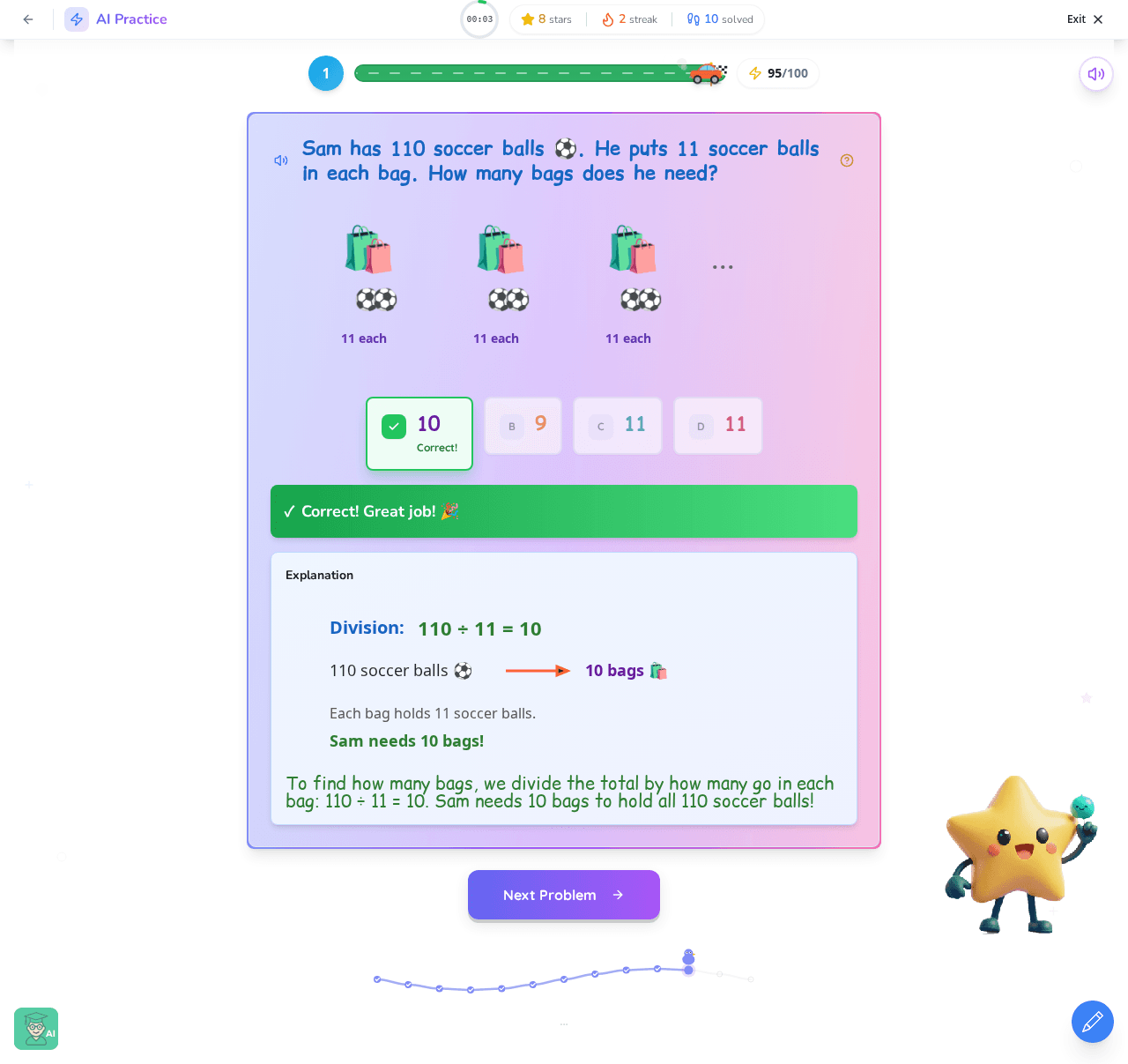
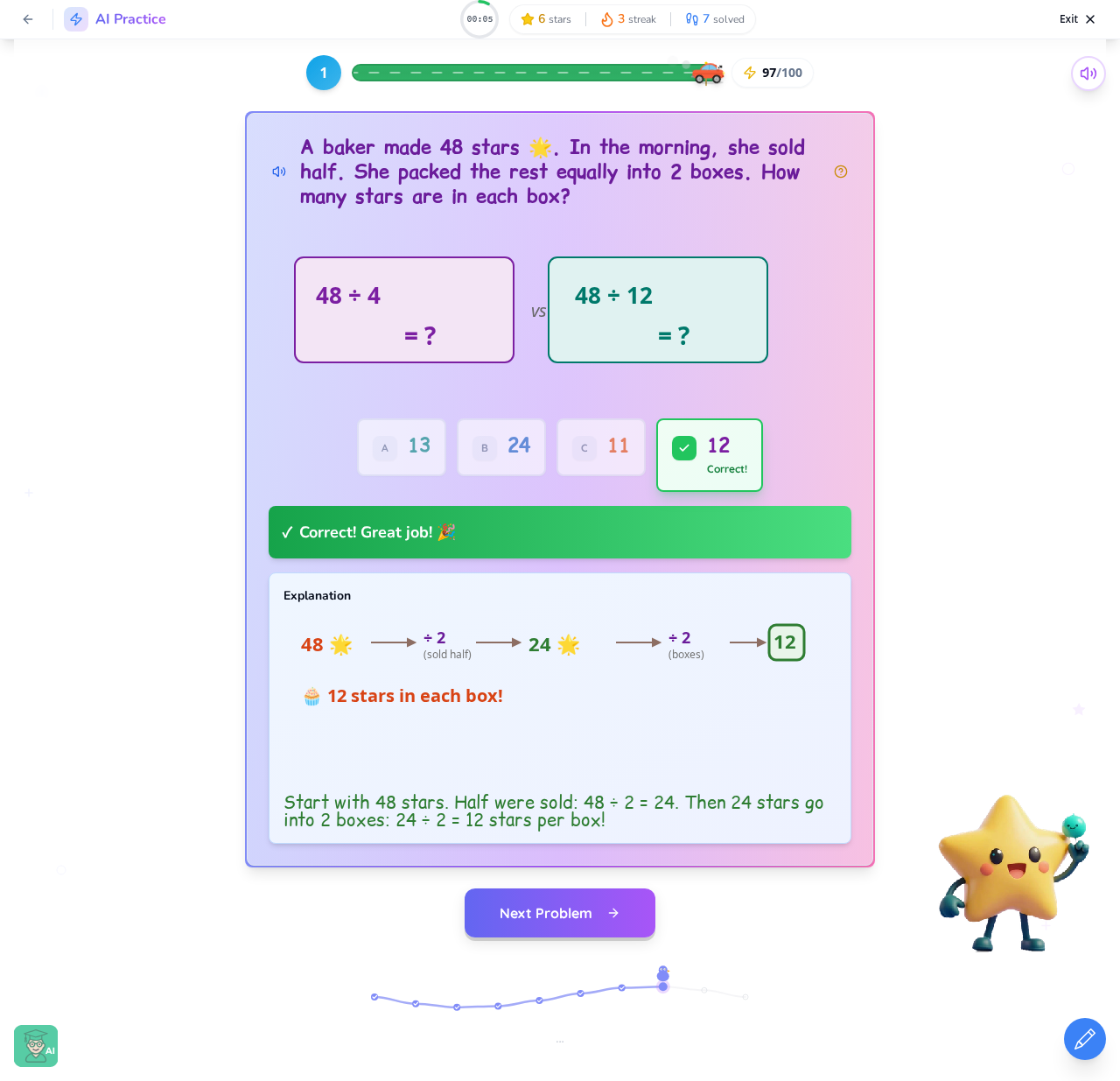
Look for division scenarios in daily life: splitting a restaurant bill, dividing a pizza, organizing items into equal groups. The interactive problem below shows exactly how real-world scenarios make division click for kids.
Word problems like a baker sharing muffins equally or friends dividing stickers help children recognize that division isn't abstract math. It's something they'll use throughout their lives.
See Division Facts in Action with AI Teacherly
Understanding the multiplication-division connection is one thing. Practicing it in an engaging way is another. That's where interactive learning makes a real difference.
The Division Facts to 12 lesson on AI Teacherly brings these concepts to life through guided instruction and hands-on practice problems. Instead of static worksheets, your child works through visual scenarios that make division tangible and memorable.
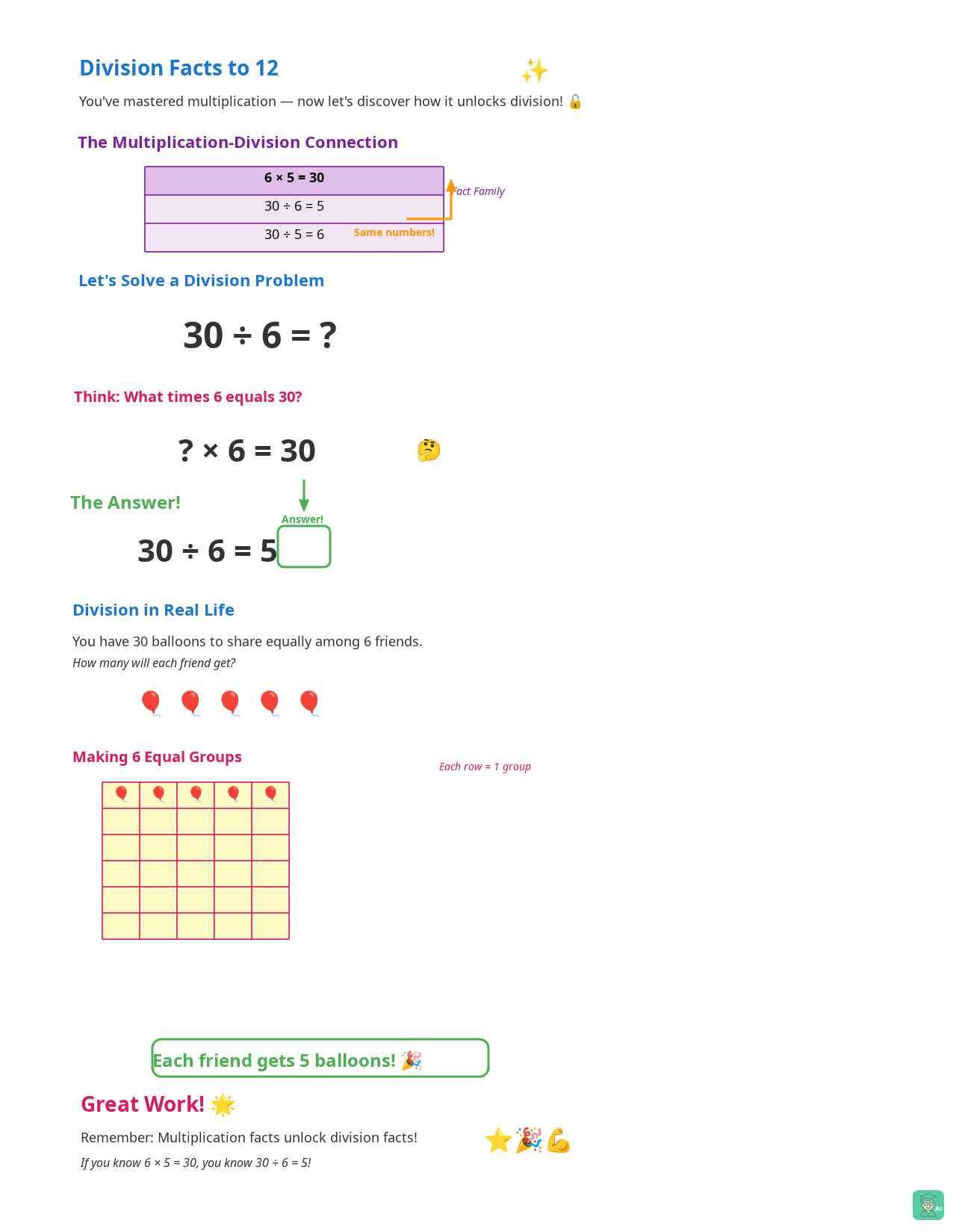
Here's what the full interactive lesson looks like on AI Teacherly:
The lesson starts by revealing the "secret" that multiplication facts unlock division facts, building confidence before diving into practice. Through colorful word problems featuring real-world scenarios (sharing items among friends, dividing objects into groups), students see how division applies to situations they encounter every day.
What makes this approach effective:
- Visual learning: Problems include images and scenarios that make abstract numbers concrete
- Immediate feedback: Children know right away whether they've got it right, reinforcing correct thinking
- Progressive difficulty: The lesson builds from simple facts to more challenging word problems
- The fact family approach: Throughout the lesson, students practice recognizing how three numbers connect through multiplication and division
Parents tell us that their children often don't realize they're "doing math" when working through these interactive problems. That's the goal: practice that feels more like play than work, while building genuine mathematical fluency.
Common Division Mistakes and How to Fix Them
Even with the best strategies, certain division mistakes crop up repeatedly. Knowing what to look for helps you catch and correct these issues before they become habits.
Mistake 1: Confusing the Dividend and Divisor
Children sometimes mix up which number goes where. In 48 ÷ 6 = 8, the dividend (48) is the total being divided, and the divisor (6) is the number of groups or size of each group. Help by consistently asking, "What's the big number being split up?"
Mistake 2: Not Connecting to Multiplication
When a child stares blankly at a division problem without thinking of the related multiplication fact, gently prompt: "What multiplication fact uses these numbers?" Rebuilding this bridge each time strengthens the connection.
Mistake 3: Guessing Instead of Reasoning
Some children rush and guess rather than thinking through the fact family. Encourage them to pause and verify: "Does your answer make sense? Can you check it with multiplication?" If they say 56 ÷ 7 = 9, ask them to check: 7 × 9 = 63, not 56. The self-checking habit is invaluable.
Mistake 4: Struggling with Division by 1 and by Itself
Rules like "any number divided by 1 equals itself" and "any number divided by itself equals 1" can seem confusing. Use concrete examples: "If you have 8 cookies and put them all in 1 bag, how many are in the bag?" (8). "If you share 8 cookies equally among 8 friends, how many does each get?" (1).
Patience and consistent practice are the keys. Each mistake is simply a learning opportunity in disguise.
Key Takeaways for Parents
Mastering division facts to 12 is within your child's reach, especially when you leverage what they already know. Here's a quick summary of everything we've covered:
Division and multiplication are two sides of the same coin. If your child knows 6 × 8 = 48, they already know 48 ÷ 6 = 8 and 48 ÷ 8 = 6.
Fact families are your best friend. Teaching your child to see three numbers (like 6, 8, and 48) as a connected family makes division feel familiar, not foreign.
"Think multiplication" is a powerful prompt. When facing any division problem, have your child ask: "What times this number equals that number?"
Real-world practice sticks. Use sharing scenarios, cooking, and everyday situations to reinforce division concepts in memorable ways.
Interactive practice beats worksheets. Engaging lessons like AI Teacherly's Division Facts to 12 make practice enjoyable while building real fluency.
Mistakes are learning opportunities. Watch for common errors and gently guide your child back to the multiplication connection.
Consistency matters more than duration. Short, daily practice sessions (even 10 to 15 minutes) build fluency more effectively than occasional long cramming sessions.
The 4th grade division hurdle is real, but it's absolutely conquerable. Your child's multiplication knowledge is the foundation; all they need is the bridge to see how it connects to division.
Key Takeaways
- Division and multiplication are connected through fact families: knowing 6×8=48 means knowing 48÷6=8 and 48÷8=6
- Use the 'think multiplication' strategy: for any division problem, ask 'What times this number equals that number?'
- Real-world sharing scenarios (snacks, toys, pizza) make division tangible and memorable for children
- Short, consistent daily practice (10-15 minutes) builds fluency faster than occasional long study sessions
- Interactive lessons that use visual word problems help children see division as practical, not abstract
- Common mistakes like confusing dividend and divisor can be fixed by consistently connecting back to multiplication
- Your child's multiplication knowledge is the foundation; they just need help seeing the bridge to division
Frequently Asked Questions
What division facts should a 4th grader know?
A 4th grader should know division facts to 12, including all problems where the dividend is up to 144 (12×12) and divisors are 1-12. This means fluency with facts like 72÷8=9, 56÷7=8, and 144÷12=12.
How do I explain division using multiplication?
Teach the 'think multiplication' trick: for 48÷6, ask 'What times 6 equals 48?' Since 6×8=48, the answer is 8. Division is simply multiplication in reverse, using the same fact families.
What is a fact family in division?
A fact family is a set of related math facts using the same three numbers. For example, 6, 8, and 48 form a family: 6×8=48, 8×6=48, 48÷6=8, and 48÷8=6. One multiplication fact unlocks two division facts.
Why is division harder than multiplication for kids?
Division feels harder because it's taught later and seems like a 'new' operation. But it's actually just multiplication viewed differently. Once children see the fact family connection, division becomes much easier because they already know the underlying facts.
How can I help my child memorize division facts?
Focus on understanding, not memorization. Teach the multiplication-division connection through fact families, use real-world sharing scenarios, and practice with interactive lessons. Fluency comes from understanding patterns, not rote memorization.
How long does it take to learn division facts to 12?
With consistent daily practice of 10-15 minutes, most 4th graders can achieve fluency in division facts to 12 within 4-8 weeks. The key is regular, engaging practice rather than occasional long sessions.
What are good division practice activities for home?
Try sharing games with snacks or toys, fact family triangles, real-world word problems (splitting pizza, dividing items), and interactive online lessons. Make it hands-on and connect division to everyday situations your child encounters.
Should my child memorize division facts or use strategies?
Start with strategies like 'think multiplication' and fact families. Understanding the relationships builds both fluency AND number sense. Eventually, frequent practice makes recall automatic, but strategy-based learning creates a stronger mathematical foundation.
Ready to make division practice engaging for your 4th grader? Try the Division Facts to 12 interactive lesson free on AI Teacherly and watch the multiplication-division connection click!