Teaching Kids About Income and Taxes: What Every 5th Grader Should Know Before Their First Job
Discover how to teach your 5th grader about gross vs net income, tax deductions, and reading pay stubs. This practical guide makes financial literacy fun with interactive learning tools.
Why Your 5th Grader Needs to Understand Paychecks Now
Picture this: your child gets their first summer job, receives their first paycheck, and immediately asks, "Where did all my money go?" It's a moment every working person remembers, and it doesn't have to be confusing.
Teaching kids about income and taxes might sound like an advanced topic, but 5th graders are at the perfect age to grasp these concepts. They understand multiplication and subtraction, they're curious about how the world works, and they're old enough to connect math to real-life situations.
The truth is, financial literacy is becoming essential in today's curriculum. Many states now mandate personal finance education, recognizing that understanding money management is just as important as reading and writing. By introducing these concepts early, you're giving your child a significant advantage.
This guide will walk you through everything you need to know about explaining income and taxes to your 5th grader. You'll learn the difference between gross and net income, discover how to explain the three main types of taxes kids encounter, and find out how interactive learning tools can make these concepts stick. Best of all, you don't need to be a tax expert yourself to teach these lessons effectively.
What Is the Difference Between Gross and Net Income?
The most important concept in financial literacy for kids is understanding the difference between gross income and net income. This single distinction explains why the amount on a paycheck is different from what you actually take home.
Gross income is the total amount of money you earn before anything gets taken out. Think of it as the "big number" that shows what your work is worth. If your child earns $10 per hour and works 20 hours, their gross income is $200.
Net income is the money you actually take home after deductions. This is often called "take-home pay" because it's the real amount that ends up in your pocket or bank account. From that $200 gross income, taxes and other deductions are subtracted, leaving a smaller but more accurate number.
Here's a simple way to explain it to your child: "Gross income is like the whole pizza. Net income is what's left after everyone takes their slice. The government takes a slice for taxes, and sometimes other slices go to things like health insurance or retirement savings."
This concept surprises many adults who never learned it as children. When kids understand this distinction early, they develop realistic expectations about earning money and can better plan their finances. They won't be shocked when their $200 paycheck turns into $170 after deductions.
The key equation to remember is: Gross Income - Deductions = Net Income. This formula becomes the foundation for understanding all future financial concepts.
How Do You Explain the Three Types of Taxes to Kids?
Children encounter taxes more often than they realize. By explaining the three main types of taxes, you help them understand where their money goes and why these contributions matter for their community.
1. Income Tax: Money from Paychecks
Income tax is the portion of earnings that goes to the federal and state governments. When your child eventually gets a job, they'll see this deduction on their pay stub. The key message: this money funds national programs like military defense, national parks, and government services.
A simple explanation: "When you earn money from a job, the government takes a small piece to help run the country. It pays for things like soldiers who protect us and roads that connect different states."
2. Sales Tax: Money at the Store
This is the tax kids experience most directly. When they buy a $10 toy and the total comes to $10.80, that extra 80 cents is sales tax. Most states charge between 4% and 10% sales tax on purchases.
Try this: Next time you're shopping with your child, point out the sales tax on the receipt. Ask them to calculate what 8% of their purchase would be. It's practical math that makes percentages meaningful.
3. Property Tax: Money for Local Services
Property tax is charged on homes and land, and it funds local services like schools, libraries, fire departments, and parks. This is the tax that directly benefits your child's daily life.
Explain it this way: "The tax on our house helps pay for your school, the playground equipment at the park, and the firefighters who keep our neighborhood safe."
When children understand that taxes provide services they use every day, paying taxes feels less like losing money and more like contributing to their community.
How to Teach Your Child to Read a Pay Stub
Reading a pay stub is a practical skill that most schools skip, yet every working person needs to understand it. Teaching your 5th grader to decode a pay stub builds both math skills and financial confidence.
A pay stub contains several key sections that tell the story of how gross income becomes net income:
Hours Worked and Hourly Rate This section shows the basic calculation: hours multiplied by the hourly rate equals gross pay. For example, 40 hours × $12/hour = $480 gross pay. This reinforces multiplication skills in a real-world context.
Gross Pay (Total Earnings) The gross pay line shows the full amount earned before any deductions. Help your child identify this number first, as it's the starting point for all calculations.
Deductions Section This is where the "slices" come out of the pizza. Common deductions include:
- Federal income tax
- State income tax
- Social Security (FICA)
- Medicare
- Health insurance (if applicable)
- Retirement contributions (if applicable)
Net Pay (Take-Home Amount) The final number shows what actually goes into the bank account. Have your child verify this by subtracting all deductions from gross pay.
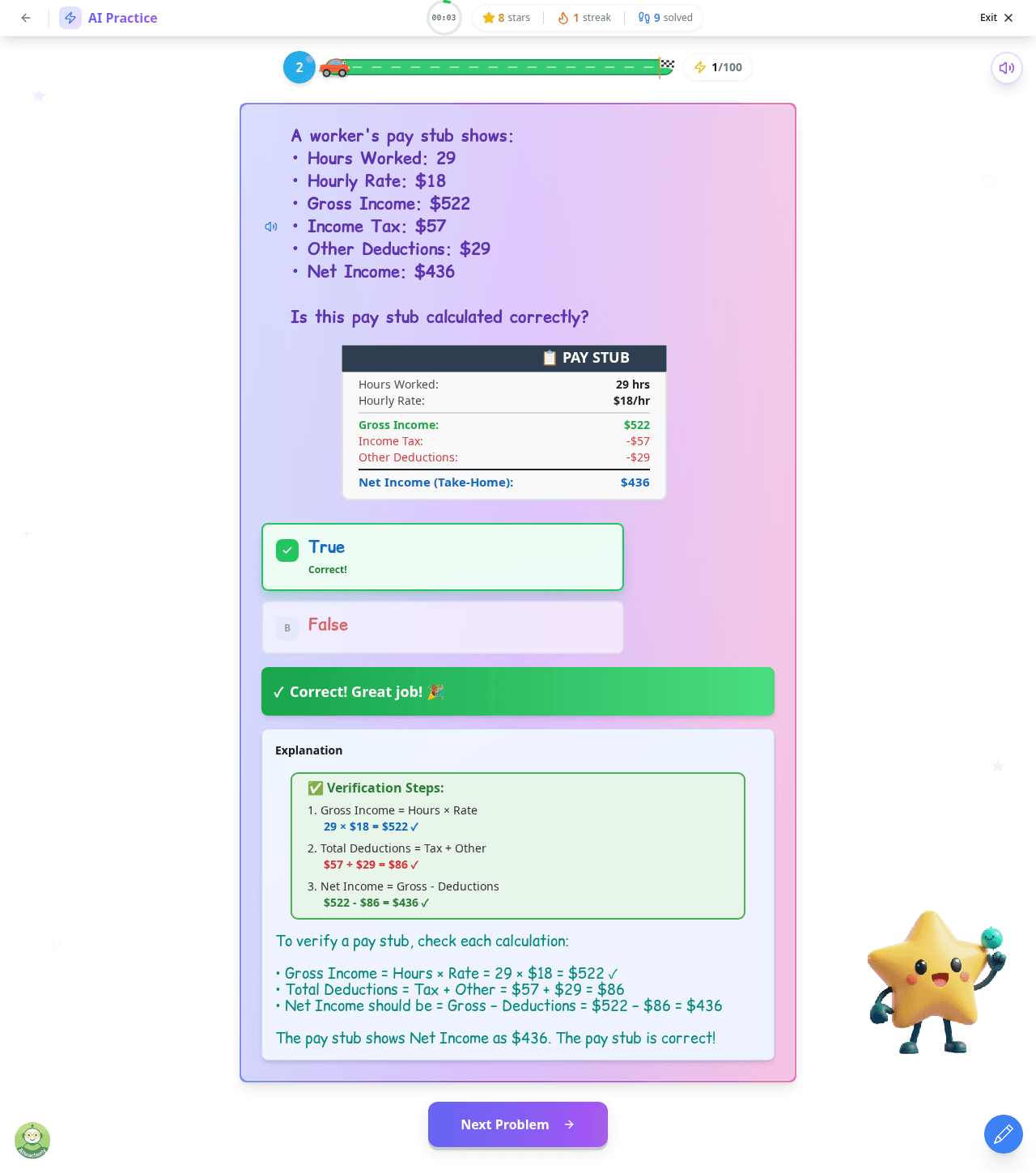
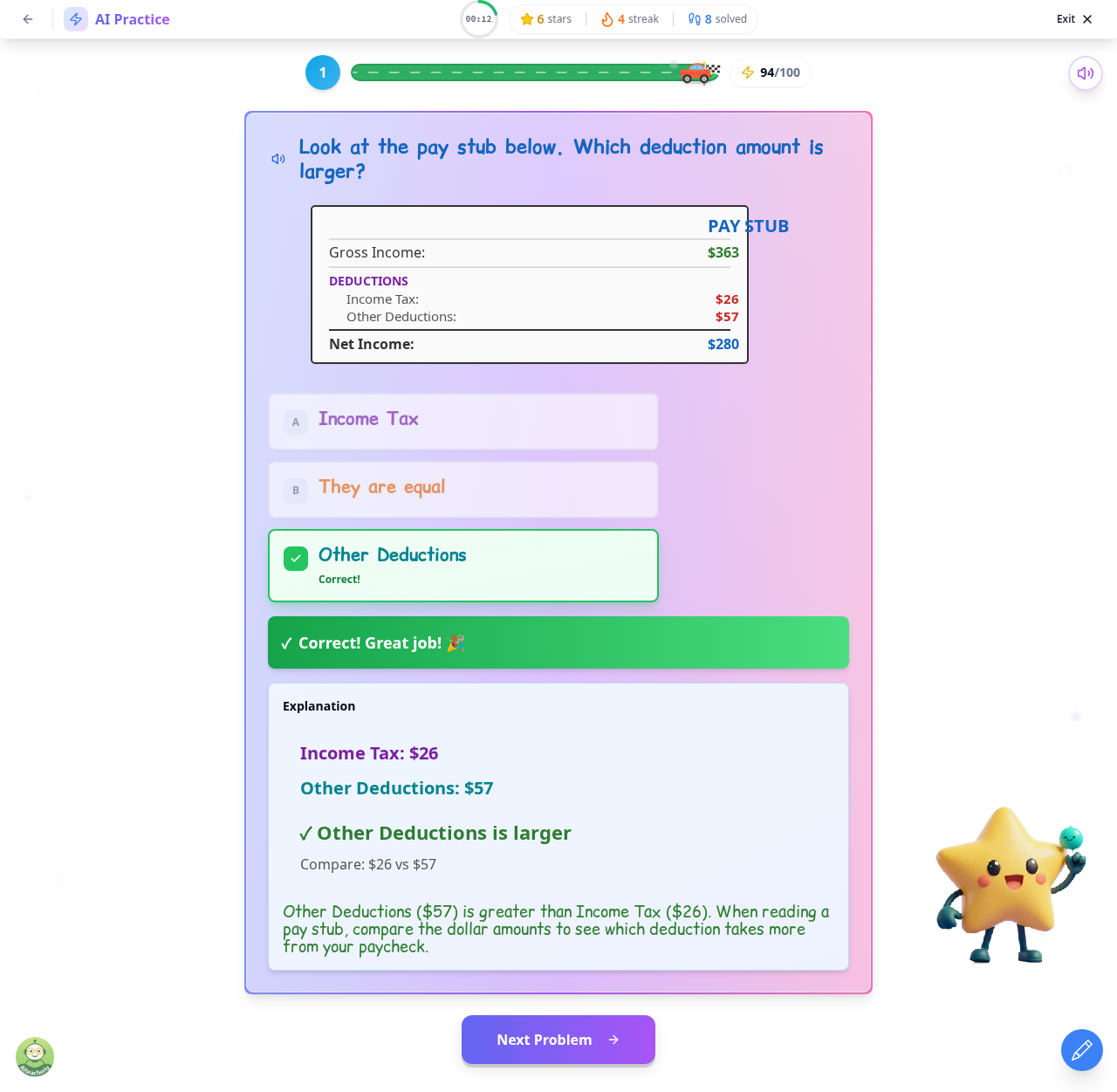
The interactive problem below demonstrates exactly how kids learn to analyze pay stub components through engaging practice questions.
Practice activity: Create a simple mock pay stub for your child. Use easy numbers: 10 hours of work at $10/hour ($100 gross), with $15 in deductions, leaving $85 net pay. Have them identify each component and verify the math.
See How Interactive Learning Makes Taxes Click
Abstract financial concepts become concrete when children can interact with them. That's where interactive learning platforms transform the experience of teaching kids about income and taxes.
Traditional worksheets can explain gross and net income, but they can't show the dynamic relationship between earnings and deductions. Interactive lessons allow children to:
Manipulate Variables in Real Time What happens when the hourly rate increases? When hours worked change? When tax rates adjust? Interactive tools let kids experiment with these variables and see immediate results, building intuitive understanding.
Practice with Realistic Scenarios Rather than abstract math problems, children work with scenarios they'll encounter in real life. They calculate net income for a summer job, figure out sales tax on purchases, and analyze authentic-looking pay stubs.
Receive Immediate Feedback When a child makes a calculation error, interactive platforms provide instant correction and explanation. This prevents misconceptions from taking root and builds confidence through successful practice.
Progress at Their Own Pace Some children grasp these concepts quickly; others need more practice. Interactive lessons adapt to each child's learning speed, ensuring mastery before moving forward.
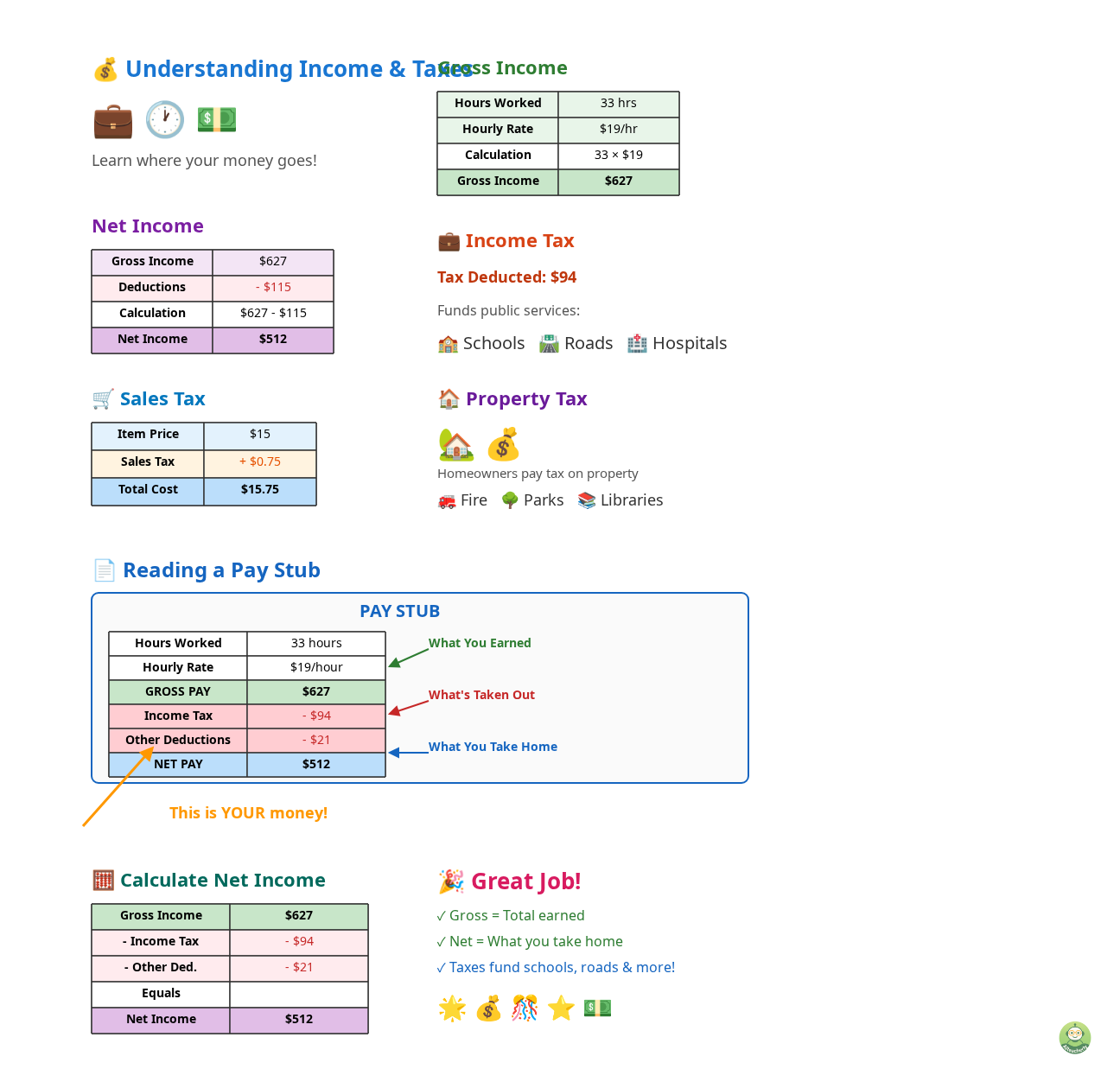
Here's what the full interactive lesson looks like on AI Teacherly:
The "Understanding Income and Taxes" lesson on AI Teacherly guides 5th graders through guided discovery of financial concepts. Students learn the difference between gross and net income, explore how taxes fund community services, and practice real calculations with pay stubs. The lesson includes visual models, step-by-step breakdowns, and practice problems that make learning money math engaging.
Interactive learning transforms a potentially dry topic into an engaging experience. Children who learn financial concepts this way retain the information longer and feel more confident applying it to real situations.
Common Mistakes Kids Make With Income Calculations
Understanding where children typically struggle helps you anticipate questions and provide clearer explanations. Here are the most common mistakes 5th graders make when learning about income and taxes, along with strategies to address them.
Mistake 1: Confusing Gross and Net Income Children often mix up which term means "before" and which means "after" deductions.
Fix it: Use memory tricks. "Gross" sounds like "grow," and the gross amount is the bigger, growing number. "Net" is what you "net" or catch after everything else is removed, like a fishing net catching what's left.
Mistake 2: Forgetting to Subtract ALL Deductions When calculating net income, kids sometimes subtract only one deduction instead of adding all deductions together first, then subtracting the total.
Fix it: Teach the two-step process: First, add all deductions together. Second, subtract that total from gross income. Write it as: Gross - (Deduction 1 + Deduction 2 + Deduction 3) = Net
Mistake 3: Misunderstanding Percentages Calculating 15% of income for taxes can be tricky. Some children multiply by 15 instead of 0.15, getting wildly incorrect answers.
Fix it: Practice converting percentages to decimals. 15% becomes 0.15 by moving the decimal point two places left. Use familiar examples: 50% is half (0.50), 25% is a quarter (0.25), 10% is one-tenth (0.10).
Mistake 4: Thinking Taxes Are "Taking" Money Unfairly Some children feel frustrated that money is "taken" from paychecks.
Fix it: Consistently connect taxes to benefits they enjoy. Every time you pass a fire station, library, or public park, mention that tax money helps pay for it. This builds a positive understanding of civic contribution.
Mistake 5: Not Checking Their Work In their eagerness to finish, kids often skip verification.
Fix it: Teach reverse calculation: Net income + Deductions should equal Gross income. If it doesn't, there's an error somewhere.
Key Takeaways
- Gross income is the total earned before deductions; net income is the take-home pay after taxes and other deductions are subtracted
- The three main taxes kids encounter are income tax (from paychecks), sales tax (at stores), and property tax (funding local schools and services)
- Teaching pay stub literacy early prepares children for their first jobs and prevents paycheck confusion
- Connect taxes to community benefits like schools, parks, and fire stations to help children understand their purpose
- Interactive learning tools make abstract financial concepts concrete through real-time practice and immediate feedback
- Use memory tricks to help children remember the difference between gross (bigger, before) and net (what's left, after)
- Practice regularly with real-world scenarios like shopping receipts and mock pay stubs to reinforce learning
Frequently Asked Questions
What is the difference between gross income and net income?
Gross income is the total money earned before any deductions. Net income is the take-home pay after taxes and other deductions are subtracted. Think of gross as the whole pizza, and net as what's left after everyone takes a slice.
How do I explain income tax to my 5th grader?
Explain that income tax is a small portion of earnings that goes to the government to pay for things everyone uses, like roads, national parks, and public safety. It's automatically taken from paychecks before you receive your money.
Is 5th grade too young to learn about taxes?
No, 5th graders have the math skills needed to understand taxes. They can multiply, work with percentages, and grasp real-world connections. Learning early builds financial confidence before their first job.
What are the three main types of taxes kids should know?
The three main types are: income tax (taken from paychecks), sales tax (added to store purchases), and property tax (charged on homes to fund local schools, libraries, and services).
Why is financial literacy important for 5th graders?
Financial literacy teaches practical math skills, prepares kids for their first jobs, and builds responsible money habits early. Many states now require personal finance education, making it an essential life skill.
How can I help my child understand a pay stub?
Walk through each section: hours worked times hourly rate equals gross pay, then identify each deduction (taxes, insurance), and finally show how gross pay minus deductions equals net pay. Use a mock pay stub with simple numbers for practice.
What math skills does learning about income and taxes teach?
Teaching income and taxes reinforces multiplication, subtraction, percentages, and multi-step problem solving. It connects abstract math concepts to real-world applications kids will use throughout their lives.
How do I make learning about taxes fun for kids?
Use interactive learning platforms, create mock pay stubs with easy numbers, point out sales tax on shopping receipts, and play games calculating percentages. Connect taxes to things they love, like parks and libraries.
Ready to make financial literacy engaging for your 5th grader? Try the interactive "Understanding Income and Taxes" lesson on AI Teacherly, where kids learn about gross income, net income, and pay stubs through hands-on practice. Start your free trial today and give your child a head start on real-world money skills!