Teaching Kindergarten Addition at Home: 5 Hands-On Activities
Discover how to teach your kindergartener addition using everyday objects and playful activities. No worksheets needed, just hands-on fun that makes math concepts click!
Why Hands-On Addition Changes Everything for Kindergarteners
Your kindergartener doesn't need worksheets to learn addition. They need to play, touch, and count real objects. This might surprise you, but the secret to teaching kindergarten addition at home isn't about flashcards or drills. It's about transforming snack time, toy cleanup, and everyday moments into powerful math lessons.
Research consistently shows that young children learn mathematical concepts best through physical manipulation. When your 5-year-old combines two piles of blocks and counts the total, they're not just playing. They're building the neural pathways that make abstract math concepts click later on.
The beautiful part? You don't need special training or expensive materials. The items already in your home (toys, snacks, crayons, socks) are perfect addition manipulatives. And the best news for busy parents: these activities take just 5 to 10 minutes and fit naturally into your daily routine.
In this guide, you'll discover exactly how kindergarteners understand addition, a simple step-by-step method you can use tonight, and five everyday activities that make addition feel like play rather than work.
What Does Addition Really Mean for a 5-Year-Old?
Before exploring the activities, let's understand what's happening in your kindergartener's brain when they learn addition. This knowledge will make you a more effective teacher.
Addition is "putting together." That's the core concept your child needs to grasp first. It's not about memorizing that 2 + 3 = 5. It's about understanding that when you have 2 things and get 3 more things, you can count them all together to find the total.
This is why hands-on addition for kindergarten works so well. When children physically move objects into one group and count them, they experience what the plus sign actually means. As educators often say: "See the plus sign? It means put together!"
The developmental progression matters:
- Concrete stage: Children manipulate real objects (toys, blocks, snacks)
- Pictorial stage: Children work with pictures of objects
- Abstract stage: Children understand number sentences like 2 + 3 = 5
Most kindergarteners are firmly in the concrete stage, which is exactly where they should be. Rushing to abstract number sentences before they've had enough hands-on experience often leads to memorization without understanding. That's why visual addition methods are so powerful at this age.
How Do I Teach My Kindergartener Addition Step-by-Step?
Here's a simple four-step process that mirrors how children naturally learn addition. Use this method with any objects you have handy.
Step 1: Make Two Groups Start with two small groups of objects. For example, put 2 toy cars on the left and 3 toy cars on the right. Keep numbers small at first (sums to 5 work best for beginners).
Step 2: Count Each Group Have your child count the first group: "One, two. There are 2 cars here." Then count the second group: "One, two, three. There are 3 cars here." This builds anticipation and reinforces one-to-one correspondence.
Step 3: Put Together and Count All Say "Now let's put them together!" and physically move the groups into one pile. Then count all the objects: "One, two, three, four, five. We have 5 cars altogether!"
Step 4: Connect to Language Now add the math language: "We had 2 cars and 3 more cars. 2 plus 3 equals 5. Adding is putting things together!"
Pro tip: Let your child do the physical combining and counting. Your job is to guide and narrate. The more they handle objects themselves, the deeper their understanding becomes.
Start with sums to 5, and once your child shows confidence (usually getting answers right without counting each time), gradually move to sums within 10.
5 Everyday Activities That Make Addition Fun at Home
The best kindergarten addition activities don't feel like learning at all. Here are five ways to weave addition practice into your daily routine:
1. Snack Time Math Before giving your child crackers, grapes, or berries, make two small piles. "You have 3 crackers here and 2 crackers here. How many will you have if we put them together?" Count together, then enjoy the snack as a reward.
2. Toy Cleanup Challenge "You put 4 blocks in the bin, now add 2 more. How many blocks are in the bin now?" This transforms a chore into a game and provides natural counting practice.
3. Staircase Addition As you climb stairs together, count steps in groups. "We went up 3 steps, now 2 more. How many steps did we climb?" The physical movement makes the math memorable.
4. Getting Dressed "You have 1 sock on. When you put on 1 more sock, how many socks will you be wearing?" This works with mittens, shoes, buttons, and more.
5. Story Time Addition While reading, pause to create addition problems from illustrations. "I see 2 birds in the tree and 3 birds on the ground. How many birds altogether?"
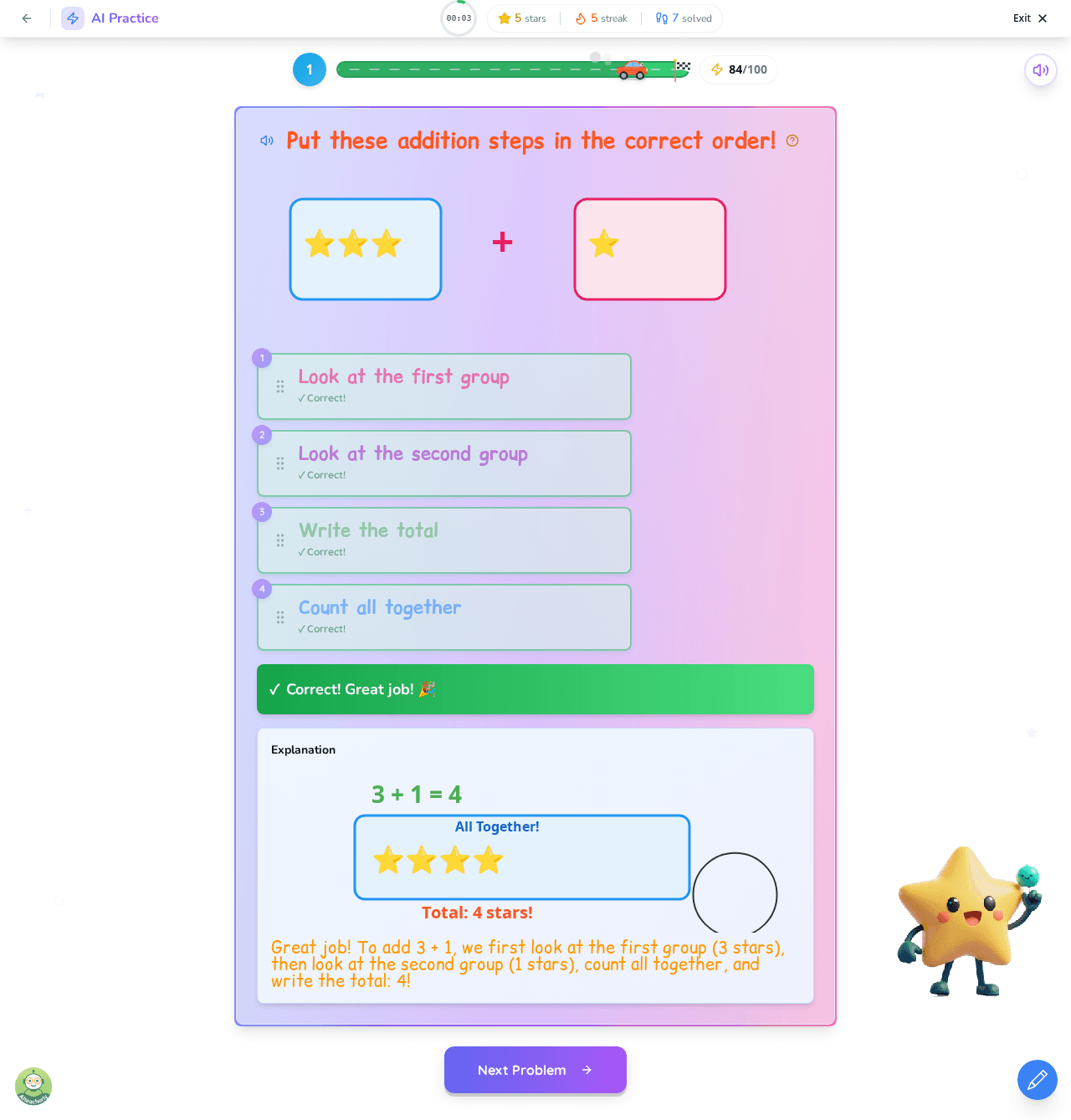
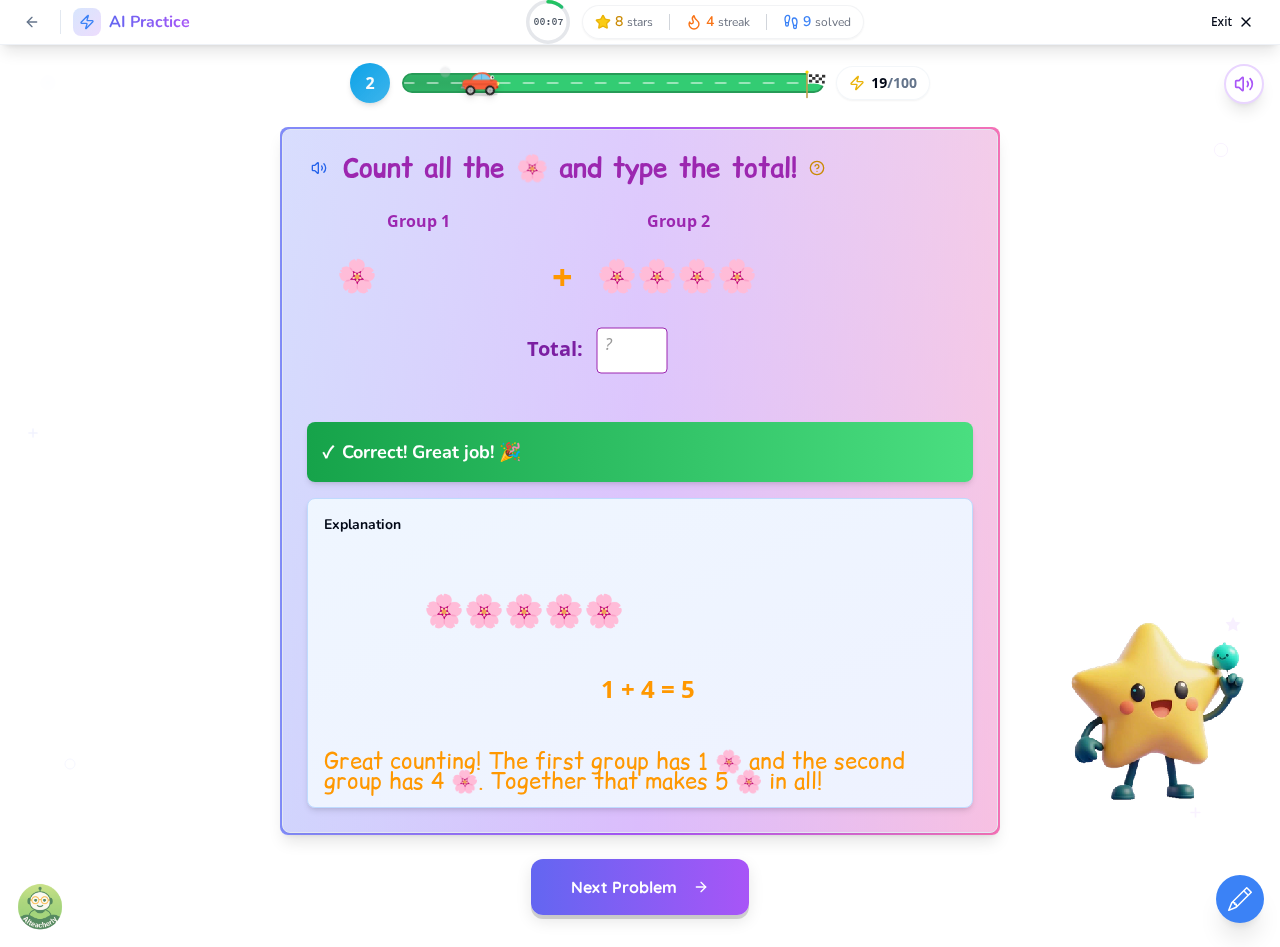
The interactive problem below shows exactly how visual addition works in practice. Notice how children count colorful objects before finding the sum:
Remember: Keep sessions short (5 to 10 minutes), end on a success, and never force practice when your child seems frustrated.
See Interactive Addition in Action
Wondering what effective addition instruction looks like? Interactive digital lessons can reinforce the hands-on skills you're building at home.
On AI Teacherly, the Introduction to Addition lesson for kindergarteners follows the exact same concrete-to-abstract progression we've discussed. Children see colorful objects, combine them visually, and gradually connect the experience to number sentences.
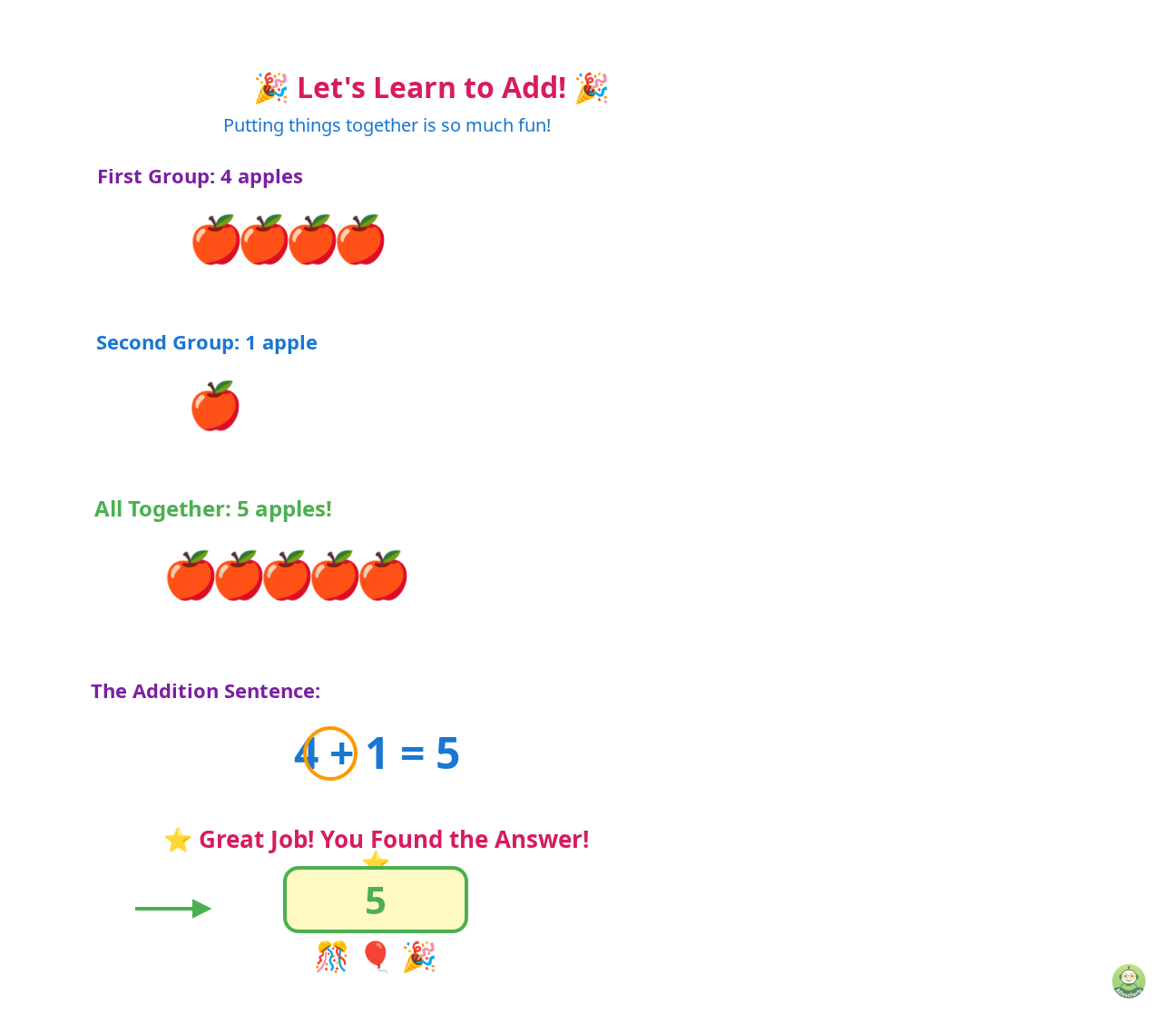
Here's what the full interactive lesson looks like on AI Teacherly:
The lesson includes:
- Guided instruction with encouraging narration ("Adding is putting things together!")
- Visual problems using emojis and pictures that children love
- Step-by-step scaffolding that builds from counting to number sentences
- Immediate feedback that celebrates correct answers and gently guides corrections
- Multiple problem types including matching, ordering, and fill-in-the-blank
What makes interactive lessons valuable is the repetition with variety. Your child practices the same concept in different contexts, which deepens understanding without boring repetition.
The combination of hands-on activities at home plus engaging digital practice creates a powerful learning loop. Children understand the concept through physical manipulation, then reinforce it through interactive problems that feel like games. Try the Introduction to Addition lesson to see this approach in action.
Common Mistakes Parents Make When Teaching Addition
Even well-meaning parents can accidentally make addition harder for kindergarteners. Here's what to avoid:
Mistake 1: Starting Too Abstract Jumping straight to number sentences (3 + 2 = ?) without concrete experience confuses young learners. Always start with objects, then pictures, then symbols.
Mistake 2: Using Numbers That Are Too Large Stick to sums within 5 initially. Once your child masters these, move to sums within 10. Larger numbers overwhelm working memory and increase frustration.
Mistake 3: Correcting Too Quickly When your child makes a mistake, resist the urge to immediately say "No, it's 5." Instead, guide them back: "Let's count together again. Show me with your fingers."
Mistake 4: Making Practice Feel Like a Test The moment addition feels like a chore or evaluation, motivation plummets. Keep the playful spirit. Celebrate effort, not just correct answers.
Mistake 5: Skipping the "Why" Children need to understand that the plus sign means "put together" before they can use it meaningfully. Don't assume they know; explain and demonstrate repeatedly.
Mistake 6: Practicing Too Long Kindergarteners have limited attention spans for focused tasks. Five to ten minutes of engaged practice beats thirty minutes of distracted drilling every time.
If your child shows signs of frustration (sighing, looking away, saying "I can't"), take a break. Return to easier problems or switch activities entirely. Positive associations with math are more valuable than any single practice session.
Key Takeaways: Your Addition Teaching Checklist
Ready to start teaching kindergarten addition at home? Here's your quick reference checklist:
✅ Start with objects your child can touch, move, and count. Toys, snacks, blocks, and household items all work perfectly.
✅ Keep numbers small by beginning with sums to 5, then gradually increasing to sums within 10 as confidence grows.
✅ Follow the four-step method: Make two groups → Count each group → Put together → Count the total and connect to language.
✅ Use everyday moments like snack time, cleanup, stairs, and storytime for natural addition practice.
✅ Emphasize "putting together" as the core meaning of addition. Say it often: "Adding is putting things together!"
✅ Keep sessions short and positive with 5 to 10 minutes of engaged practice, always ending on a success.
✅ Combine hands-on play with interactive digital practice to reinforce concepts through variety.
Remember: Your kindergartener isn't behind if they need to count on fingers or use objects. That's exactly how addition understanding develops. The goal isn't memorization; it's building the foundation that makes math make sense for years to come.
Key Takeaways
- Start with physical objects your child can touch and count before introducing number sentences
- Keep numbers small with sums to 5 initially, then gradually increase to sums within 10
- Follow the four-step method: make two groups, count each, combine, then count the total
- Transform everyday moments like snack time and cleanup into natural addition practice
- Keep practice sessions short (5-10 minutes) and always end on a positive note
- Remember that using fingers and objects is developmentally appropriate and builds understanding
- Combine hands-on activities with interactive digital lessons for reinforcement
Frequently Asked Questions
What age should children start learning addition?
Most children are ready for basic addition concepts around age 4 to 5, typically in preschool or kindergarten. Start with sums to 5 using physical objects before progressing to larger numbers.
How do I explain addition to a kindergartener?
Tell them "addition means putting things together." Use two groups of toys or snacks, count each group, push them together, then count the total. Physical manipulation makes the concept click.
What household items can I use to teach addition?
Use any small objects: blocks, toy cars, crayons, LEGO bricks, snacks like crackers or grapes, buttons, coins, or stuffed animals. Variety keeps practice interesting.
How long should kindergarten math practice sessions be?
Keep sessions to 5 to 10 minutes. Short, focused practice beats long, distracted sessions. End while your child is still engaged and successful.
Why is hands-on learning important for teaching addition?
Young children's brains develop mathematical understanding through physical manipulation. Touching and moving objects builds neural pathways that make abstract concepts meaningful later.
What comes after my child masters adding to 5?
Progress to sums within 10, then introduce subtraction as "taking away." Also explore different addition representations: number lines, ten frames, and simple word problems.
How do I know if my kindergartener is ready for addition?
They're ready if they can count objects to 10 with one-to-one correspondence (touching each object once while counting) and understand that numbers represent quantities.
What if my child gets frustrated with addition?
Stop the activity immediately and return to easier problems or switch to something else. Never push through frustration. Keeping math positive matters more than any single practice session.
Ready to make addition fun for your kindergartener? Try the free Introduction to Addition lesson on AI Teacherly and watch your child discover the joy of putting numbers together!