Teaching Patterns to Kindergarteners: 5 Playful Activities That Build Real Math Skills
Discover how to unlock your kindergartener's natural pattern-spotting abilities with playful activities that build real math skills. No teaching degree required!
Your Kindergartener Is Already a Pattern Detective
Here's something that might surprise you: your kindergartener is already using pattern recognition every single day. They just don't know it has a fancy math name yet.
Think about it. When your child claps along to a favorite song, they're following a rhythmic pattern. When they predict that Wednesday means library day at school, they're recognizing a weekly pattern. When they notice that dad always puts on his shoes before leaving the house, they're tracking a sequential pattern.
This natural ability is your secret weapon for building early math skills.
Pattern recognition is one of the most important foundational skills in mathematics. It's the gateway to algebraic thinking, which sounds intimidating, but really just means understanding that things follow predictable rules. And the beautiful thing is that kindergarteners are naturally wired to spot these patterns. They crave predictability and find comfort in routines.
The challenge for parents isn't teaching something new. It's channeling this existing superpower into structured learning that will serve them throughout their math education. And the best news? You don't need to be a math teacher to do it. You just need a few simple strategies and some playful practice.
What Are Patterns in Kindergarten Math?
In kindergarten math, patterns are sequences that repeat in a predictable way. The simplest and most common type is called an AB pattern, where two elements alternate back and forth.
For example:
- Red, blue, red, blue, red, blue (color pattern)
- Circle, square, circle, square, circle, square (shape pattern)
- Clap, stomp, clap, stomp, clap, stomp (movement pattern)
The key concept children need to grasp is the core unit, which is the part that repeats. In an AB pattern, the core unit is just two things (like red-blue or circle-square). Once kids can identify this repeating chunk, they can predict what comes next in any pattern.
Beyond AB patterns, kindergarteners also learn:
- ABB patterns: Red, blue, blue, red, blue, blue
- ABC patterns: Red, blue, green, red, blue, green
- Growing patterns: Patterns that increase in size or number
Understanding patterns helps children see that math isn't random. It follows rules. When children say, "I know what comes next!" they're building the logical thinking skills that will help them with addition, multiplication, and eventually algebra. That's why early educators call pattern recognition the foundation of algebraic thinking.
Why Is Pattern Recognition Important for Early Math?
You might wonder why so much kindergarten math time is devoted to colored shapes and sequences. The answer goes deeper than you might expect.
Pattern recognition builds predictive thinking. When children identify what comes next in a sequence, they're making logical predictions based on observed rules. This is the same mental process they'll use later for solving equations and understanding mathematical relationships.
It develops working memory. To extend a pattern, children must hold the core unit in their minds while applying it forward. This exercises the same cognitive muscles needed for multi-step math problems.
It creates a foundation for number sense. Our entire number system is based on patterns. Counting by 2s, 5s, and 10s are all patterns. The place value system (ones, tens, hundreds) follows a pattern. Skip counting, which is essential for multiplication, relies on recognizing numerical patterns.
It connects math to the real world. Children who understand patterns start seeing them everywhere: in floor tiles, in nature, in music, in daily schedules. This helps them understand that math isn't just something that happens in workbooks.
Research shows that children with strong pattern recognition skills in kindergarten demonstrate better overall math performance in later grades. It's not just about knowing what color comes next; it's about training the brain to find order and make predictions.
How to Teach Patterns to Your Kindergartener at Home
Teaching patterns at home doesn't require special materials or a teaching degree. Here are five proven activities that turn everyday moments into pattern practice:
1. The Snack Pattern Game Use two types of snacks (like grapes and cheese cubes, or goldfish crackers and pretzels) to create edible patterns. Start with AB patterns: grape, cheese, grape, cheese. Ask your child to continue the pattern, then eat it together! This makes abstract concepts deliciously concrete.
2. Sound and Movement Patterns Create patterns using body movements: clap, stomp, clap, stomp. Or try snap, clap, clap, snap, clap, clap. Children love the physical engagement, and hearing the rhythm helps reinforce the repeating unit. Bonus: this is a great energy-burner!
3. Nature Walk Pattern Hunt Take a walk and look for patterns in nature: stripes on a caterpillar, petals around a flower center, fence posts in a row. Point them out and ask, "What do you notice repeating?" This builds observation skills alongside pattern recognition.
4. Building Block Sequences Use LEGO bricks, blocks, or even crayons to build physical patterns. The tactile experience of placing objects in sequence reinforces learning through multiple senses. Challenge your child to create their own pattern for you to continue.
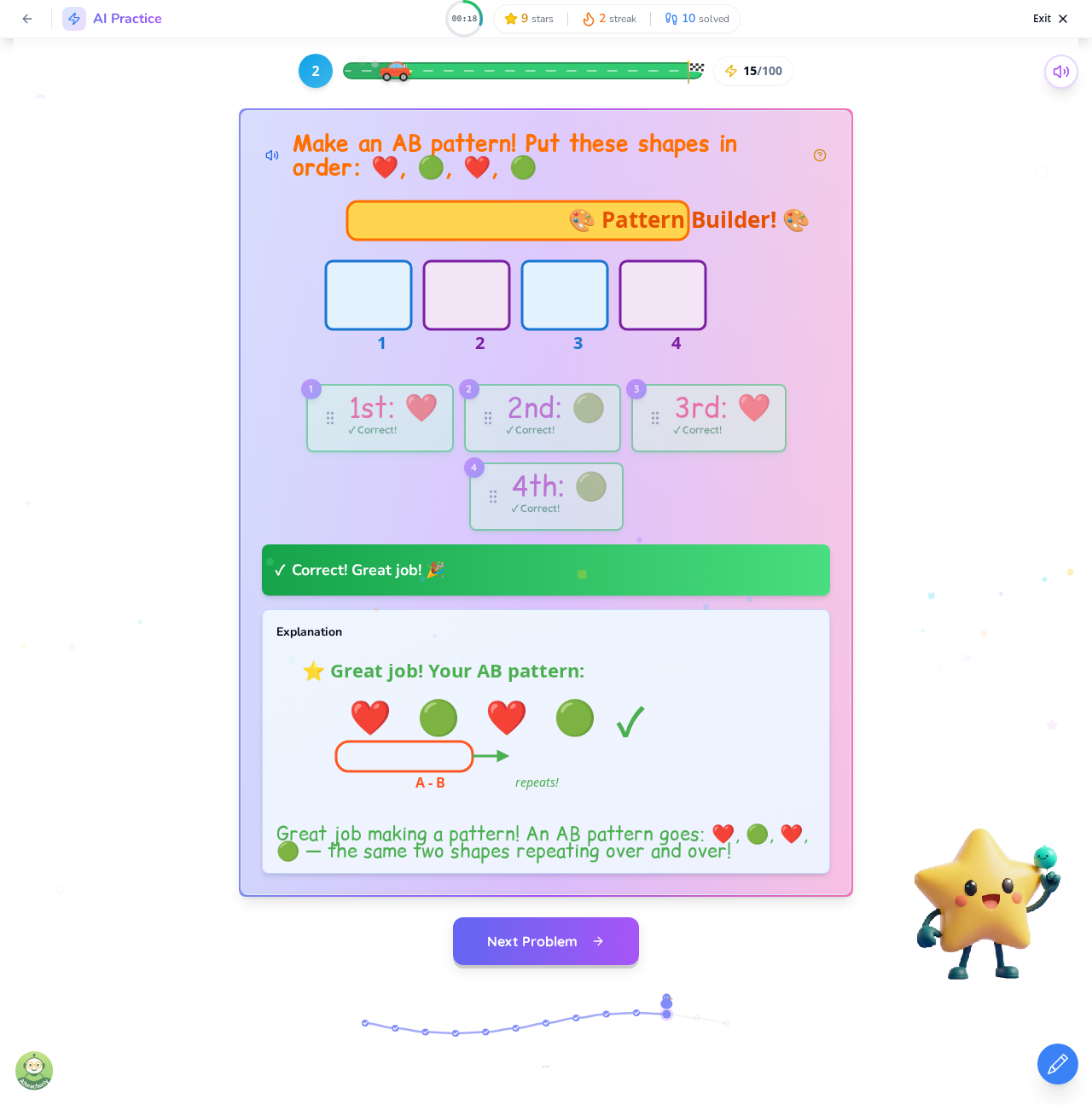
5. Interactive Digital Practice Complement hands-on activities with engaging digital lessons that provide immediate feedback. The interactive problem below shows how children can practice creating patterns by dragging shapes into the correct sequence:
See How Interactive Pattern Learning Works
One of the best ways to reinforce pattern skills is through interactive practice that gives children immediate feedback. Unlike worksheets where kids wait for a parent or teacher to check their work, interactive lessons let them see right away if they've got it right.
This kind of instant feedback is powerful for kindergarteners. When they place the correct shape in a pattern sequence and see it light up or hear a cheerful sound, their brain gets a dopamine hit that reinforces the learning. When they make a mistake, they can try again without embarrassment.
Here's what the full interactive lesson looks like on AI Teacherly:
The AI Teacherly Color and Shape Patterns lesson for Kindergarten guides children through progressively challenging activities:
- Identifying patterns: "Is this a pattern? How do you know?"
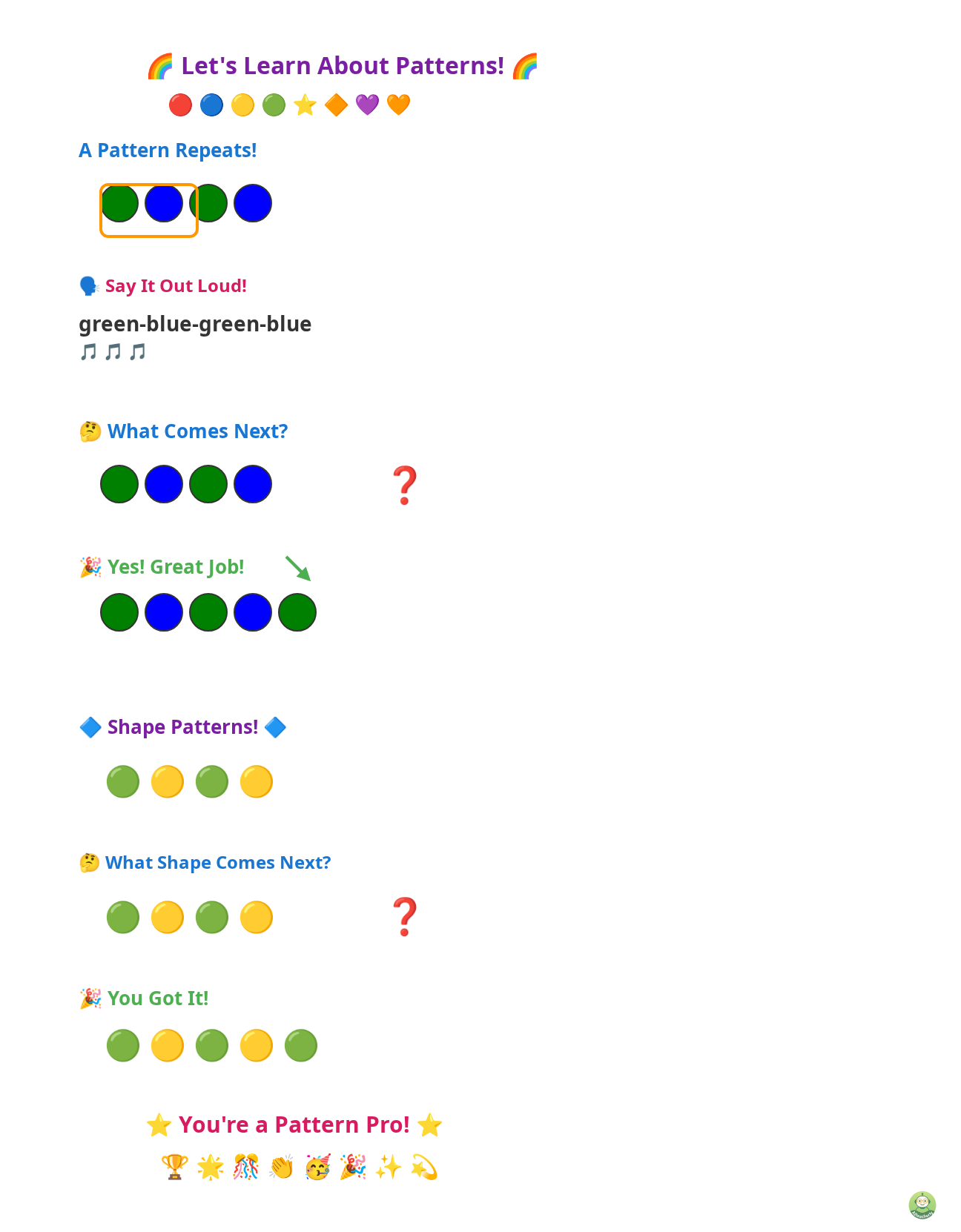
- Continuing patterns: "What comes next?"
- Creating patterns: Building their own AB and ABB sequences
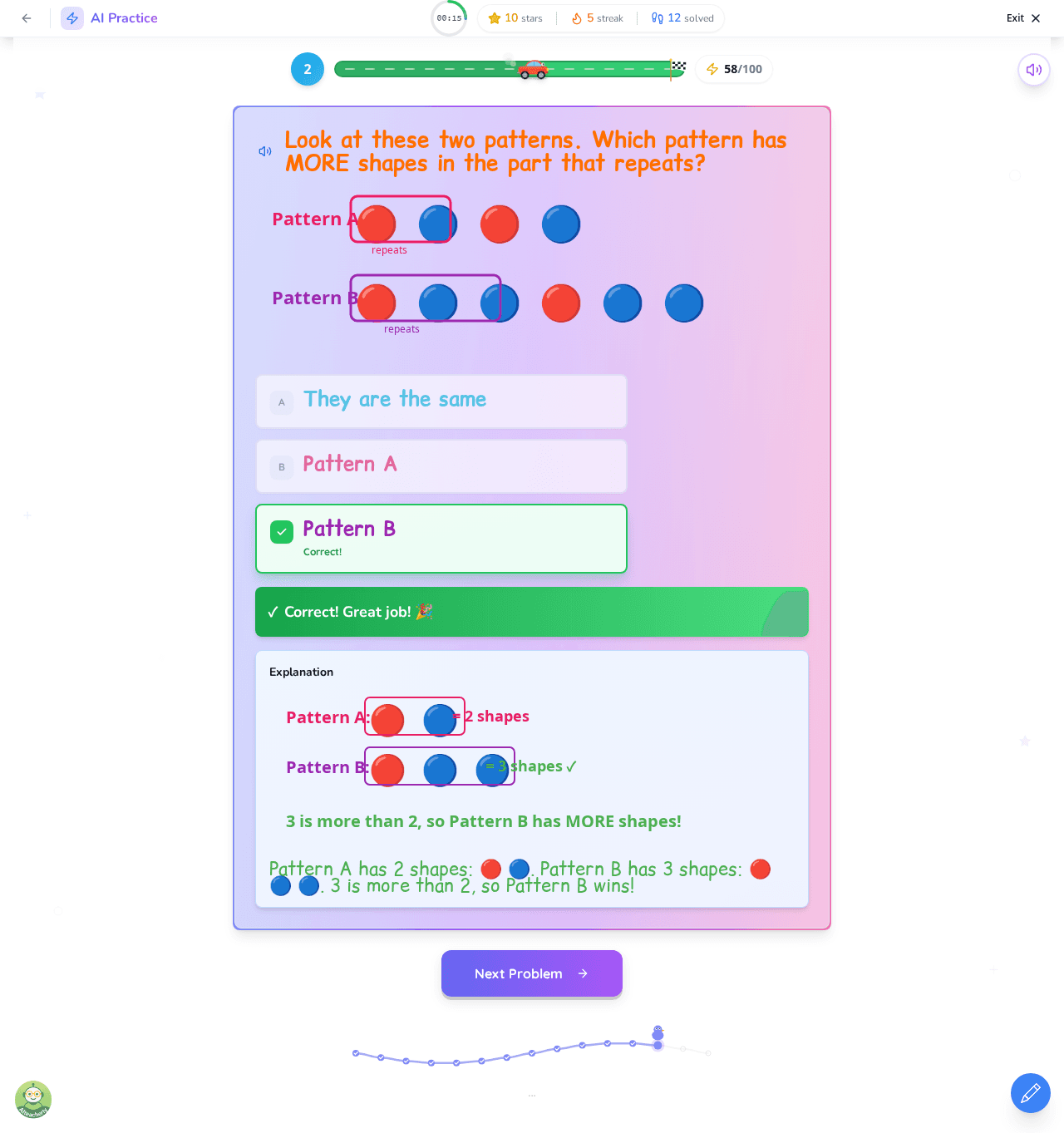
- Comparing patterns: Spotting which sequence follows the correct rule
Each activity uses colorful, engaging visuals that hold kindergarteners' attention while building genuine mathematical understanding. The lesson takes about 20 minutes, making it perfect for a focused learning session that doesn't overstay its welcome.
What parents love most is that they can see exactly what their child is practicing without having to become math teachers themselves. The lesson does the heavy lifting; parents just provide encouragement.
Common Pattern Mistakes and How to Help
Even though patterns seem simple to adults, kindergarteners often hit some common stumbling blocks. Here's what to watch for and how to help:
Mistake #1: Random Placement Some children place colors or shapes without noticing what came before. They might put "red, blue, green, yellow" and call it a pattern because it looks pretty.
How to help: Emphasize the word "repeat." Say, "Patterns repeat over and over. Let's find the part that repeats." Have them say the pattern out loud in a rhythm to hear if it repeats.
Mistake #2: Losing Track of the Core Unit Children might start strong with "circle, square, circle, square" but then drift into "circle, square, circle, circle, square."
How to help: Point to each element as you say it together. Use your finger to group the core unit: "This part, circle-square, is what repeats. Let's put another circle-square."
Mistake #3: Getting Stuck on One Pattern Type Once kids master AB patterns, they might try to force everything into that format, even when shown an ABB pattern.
How to help: Introduce new patterns slowly. Before asking them to continue an ABB pattern, spend time just identifying the core unit together. "What part repeats? Let's count how many things are in the repeating part."
Mistake #4: Frustration with Mistakes Some children get upset when they place the wrong element in a sequence, especially in digital activities.
How to help: Normalize mistakes as part of learning. Say, "Patterns are tricky sometimes! Let's look at the beginning again and see what repeats." Celebrate the process of figuring it out, not just getting the right answer.
Remember, the goal isn't perfection. It's building the habit of looking for what repeats. That observation skill will serve them well beyond kindergarten math.
Key Takeaways
- Patterns are sequences that repeat, and recognizing them builds the foundation for algebraic thinking in later grades
- AB patterns (two alternating elements) are the starting point; the key skill is identifying the 'core unit' that repeats
- Your child already uses pattern recognition daily through songs, routines, and predictions; build on this natural ability
- Hands-on activities like snack patterns, movement sequences, and block building make abstract concepts concrete
- Interactive digital lessons provide immediate feedback that reinforces learning without requiring parents to be math experts
- Common mistakes (random placement, losing the core unit) are normal; saying patterns aloud helps children hear the rhythm
- Pattern skills directly support later math concepts including counting by 2s and 5s, place value, and multiplication
Frequently Asked Questions
What are patterns in kindergarten math?
Patterns in kindergarten math are sequences that repeat in a predictable way. The most common is the AB pattern, where two elements alternate (like red-blue-red-blue). Children learn to identify the 'core unit' that repeats and predict what comes next.
How do I teach my kindergartener to recognize patterns?
Start with familiar examples like clapping rhythms or alternating snacks. Point out the part that repeats and say it together in a rhythm. Use phrases like 'Patterns repeat over and over!' and ask 'What comes next?' to encourage prediction.
What is an AB pattern and why does it matter?
An AB pattern alternates between two elements, like circle-square-circle-square. It matters because it's the simplest pattern type and teaches children the core concept that patterns follow rules. This builds foundational algebraic thinking.
What age should kids start learning patterns?
Children naturally notice patterns around age 3-4, but formal pattern instruction typically begins in pre-K and kindergarten (ages 4-6). By age 5, most children can identify, continue, and create simple AB patterns with support.
Why does my kindergartener struggle with patterns?
Common reasons include not understanding what 'repeat' means, losing track of the core unit mid-sequence, or trying to force new patterns into familiar formats. Saying patterns aloud and physically grouping the repeating part often helps.
How can I practice patterns at home without worksheets?
Use everyday objects for hands-on practice: alternate snacks, create movement patterns (clap-stomp-clap-stomp), build sequences with blocks or LEGO, or hunt for patterns during nature walks. These tactile activities reinforce learning naturally.
Are pattern skills really connected to algebra?
Yes! Educators call pattern recognition 'early algebraic thinking.' Understanding that sequences follow predictable rules is the same concept behind algebraic equations. Kids with strong pattern skills in kindergarten tend to perform better in math overall.
How long should my kindergartener practice patterns each day?
For kindergarteners, 10-20 minutes of focused pattern practice is ideal. Short, consistent sessions are more effective than long ones. Interactive lessons like those on AI Teacherly are designed to fit this attention span perfectly.
Ready to make pattern practice fun and effective? Try the interactive Color and Shape Patterns lesson on AI Teacherly, where your kindergartener can build real math skills through play. Start exploring free today!