Teaching Perimeter to Kids at Home: 5 Easy Ways to Make It Click
Struggling to explain perimeter to your 3rd or 4th grader? Discover five hands-on activities and simple strategies that make this essential math concept finally click at home.

Why Perimeter Trips Up So Many Kids (And How You Can Fix It)
That moment when your child stares blankly at a perimeter problem doesn't mean they're bad at math. It means they need to see it in action. Perimeter is one of those concepts that sounds simple on paper but often confuses 3rd and 4th graders because it feels abstract.
Here's the good news: teaching perimeter to kids at home is easier than you think. You don't need a math degree or fancy materials. The secret lies in connecting the concept to things your child already understands, such as fences around yards, borders on picture frames, or even the edge of their favorite book.
In this guide, you'll discover exactly how to explain perimeter in simple terms, learn the three essential formulas your child needs, and get five practical activities you can do together at home. By the end, you'll have the confidence to turn perimeter homework from a struggle into a success.
Whether your child is just being introduced to perimeter in 3rd grade or reinforcing the concept in 4th grade, these strategies work. Let's make math click!
What Is Perimeter? A Simple Explanation for Parents
Perimeter is the total distance around the outside of a shape. Think of it as measuring how much fence you'd need to go all the way around a yard, or how much ribbon you'd need to wrap around a picture frame.
When explaining perimeter to a child, the key is making it tangible. Abstract definitions like "the sum of all sides" can go over their heads. Instead, try this approach:
- Point to a door and ask: "If an ant walked all the way around the edge of this door, how far would it walk?" That's perimeter!
- Use their hands: Have them trace their finger around the outside of a book or tablet. The path their finger takes is the perimeter.
- Connect to real life: Fences, borders, frames, and even the outline of a soccer field are all examples of perimeter.
The reason kids struggle isn't because perimeter is hard. It's because they haven't connected the math to something they can visualize. Once they "see" that perimeter is just measuring around something, the formulas become much easier to understand.
Remember: perimeter measures the boundary (the outside edge), not the inside space (that's area, which we'll address later to help clear up confusion).
How Do You Teach Perimeter to a Child Step by Step?
Teaching perimeter to kids at home works best when you break it into three progressive steps. This mirrors how teachers introduce the concept in school, so your child will feel confident when they see similar problems in class.
Step 1: Add All the Sides
Start with the most basic approach: adding up every side of a shape. This works for any polygon, whether it's a triangle, rectangle, pentagon, or irregular shape.
Example: A triangle has sides of 3 cm, 4 cm, and 5 cm. Perimeter = 3 + 4 + 5 = 12 cm.
Have your child count the sides first, then add them one by one. This builds number sense and reinforces that perimeter includes ALL sides.
Step 2: Use the Rectangle Shortcut
Once your child masters adding all sides, introduce the rectangle formula: P = 2L + 2W (or P = 2 × length + 2 × width). Explain that rectangles have two pairs of equal sides, so we can multiply instead of adding four separate numbers.
Step 3: Apply the Square Formula
Squares are even simpler! Since all four sides are equal, the formula becomes P = 4S (4 times one side). This is a great confidence booster because it feels like a "shortcut."
The progression from adding all sides to using formulas shows kids that math rewards efficiency. They're not just memorizing; they're learning to work smarter.
The 3 Perimeter Formulas Your Child Needs to Know
Let's break down the three essential perimeter formulas in simple terms. These cover virtually every perimeter problem your 3rd or 4th grader will encounter.
Formula 1: Any Polygon (Add All Sides)
P = Side 1 + Side 2 + Side 3 + ... (all sides)
This universal method works for any shape. Whether it's a triangle, pentagon, hexagon, or an irregular polygon with different side lengths, just add them all up.
When to use it: Irregular shapes, triangles, and when your child is first learning perimeter.
Formula 2: Rectangles (The Double Shortcut)
P = 2L + 2W or P = 2 × (L + W)
Rectangles have two lengths and two widths that are equal. Instead of adding four numbers (like 5 + 3 + 5 + 3), your child can double the length, double the width, and add those together.
When to use it: Any rectangle or rectangular shape (like doors, books, screens, tables).
Formula 3: Squares (The Fastest Method)
P = 4 × S (4 times one side)
Since squares have four equal sides, multiply one side by 4. Done!
When to use it: Squares, tiles, checkerboard pieces, and other equal-sided shapes.
Pro tip for parents: Help your child identify the shape FIRST before choosing a formula. Ask: "Is this a square, a rectangle, or something else?" This decision-making skill is just as important as the math itself.
5 Easy Home Activities to Practice Perimeter Without Worksheets
Forget boring worksheets. These hands-on activities make teaching perimeter to kids at home actually enjoyable. Use things you already have around the house.
Activity 1: The Tape Measure Challenge
Give your child a tape measure and challenge them to find the perimeter of five objects in your home: a book, a placemat, a rug, a window, and their bed. They'll practice measuring AND adding.
Activity 2: Design Your Dream Bedroom
On graph paper (or plain paper with a ruler), have your child draw a rectangular "room" and calculate how much baseboard they'd need around the edges. This connects perimeter to real renovation math!
Activity 3: LEGO Perimeter
Build different shapes using LEGO blocks and count the "studs" around the outside edge. Start with rectangles and squares, then try L-shapes for an extra challenge.
Activity 4: Outdoor Chalk Shapes
Draw large polygons on the sidewalk with chalk. Have your child walk around each shape counting steps. Then measure with a tape measure to see how close their estimate was!
Activity 5: Perimeter Scavenger Hunt
Create a list: "Find something with a perimeter greater than 50 inches." "Find a square object and calculate its perimeter." This gets kids moving and thinking.
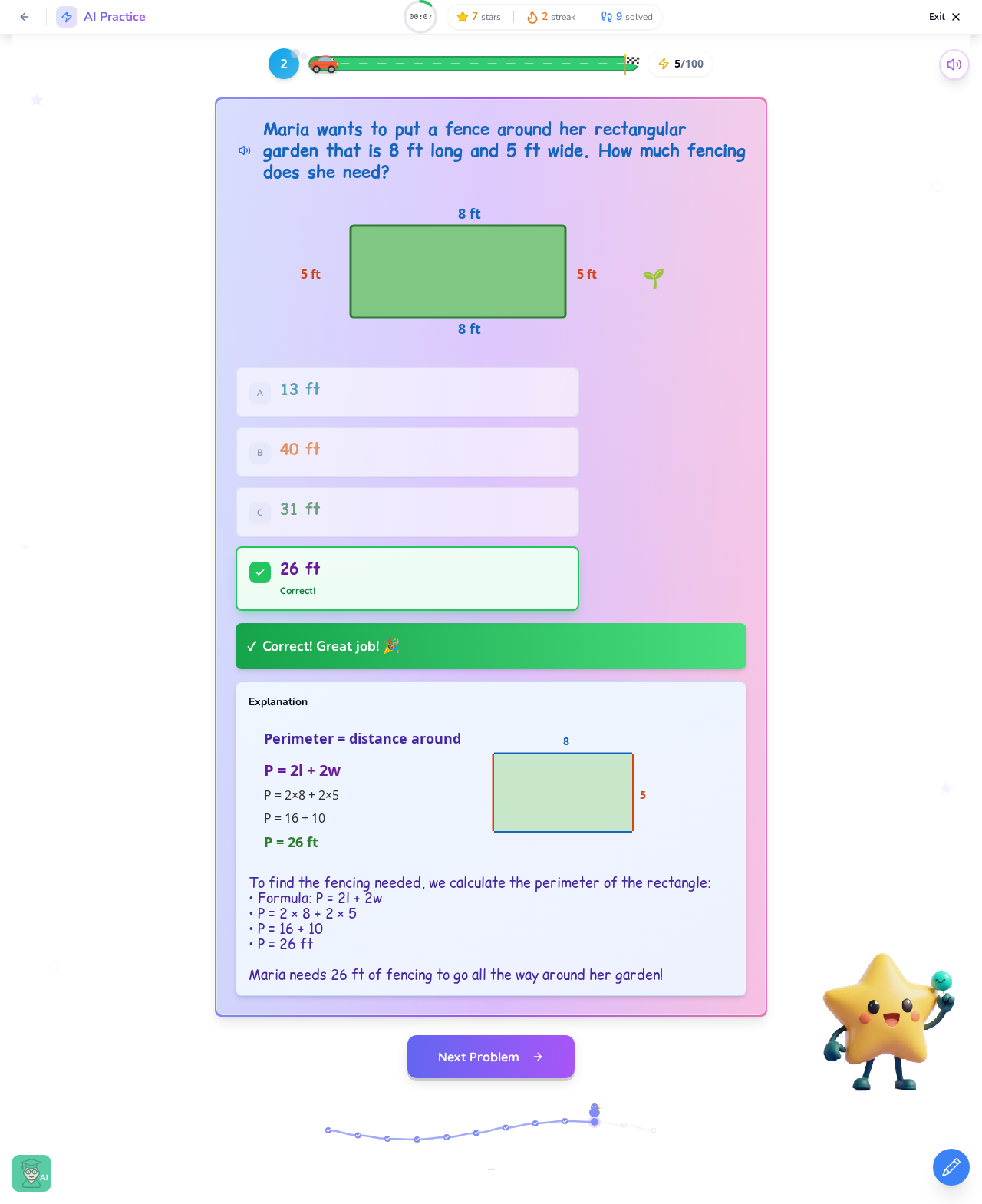
The interactive problem below shows how real-world scenarios, like Maria's garden fence, make perimeter relatable and engaging for kids:
Why these work: Active learning beats passive memorization. When kids physically measure, walk, or build, they internalize the concept of "distance around" in a way that sticks.
See How Interactive Perimeter Lessons Work
While home activities are fantastic, sometimes kids need structured practice with immediate feedback. That's where interactive lessons shine, especially for visual learners who benefit from seeing concepts animated and explained step by step.
Here's what the full interactive lesson looks like on AI Teacherly:
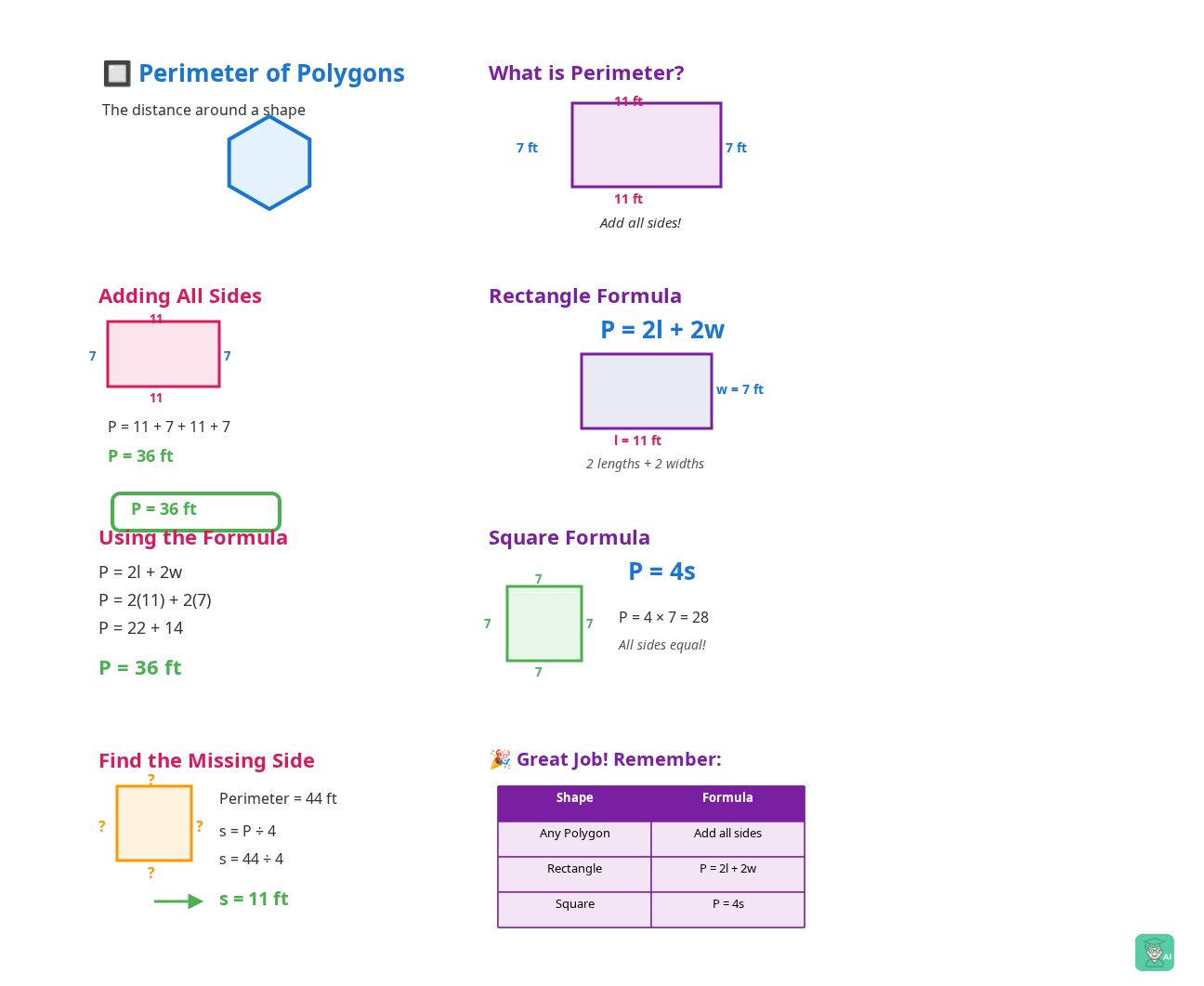
The Perimeter of Polygons lesson on AI Teacherly takes your child through the complete learning journey:
- Visual explanations that show perimeter being "drawn" around shapes
- Real-world examples like measuring fence around a garden (something they can picture)
- Guided practice where they add sides with support before trying independently
- Challenge problems that build confidence, including "detective" questions where they work backwards to find missing sides
- Instant feedback so they know immediately if they're on track
One particularly powerful feature is the progression from basic addition (adding all sides) to formulas (2L + 2W for rectangles, 4S for squares). Kids learn that math isn't about memorizing; it's about finding efficient shortcuts.
The lesson also introduces "reverse perimeter" problems where kids know the total perimeter and must find a missing side. This early algebraic thinking prepares them for more advanced math while making them feel like detectives solving a mystery.
For parents short on time, interactive lessons like this provide the structured practice kids need while you focus on dinner, emails, or helping another sibling.
Common Perimeter Mistakes and How to Avoid Them
Even when kids understand the concept, small mistakes can derail their answers. Here are the most common perimeter pitfalls and how you can help your child avoid them.
Mistake 1: Confusing Perimeter with Area
The problem: Kids mix up "distance around" (perimeter) with "space inside" (area).
The fix: Use this memory trick: "Perimeter has 'rim' in it, like the rim of a glass goes around the outside." For area, think "inside the area rug."
Mistake 2: Forgetting to Add ALL Sides
The problem: When shapes have many sides, kids sometimes miss one or count a side twice.
The fix: Teach them to mark each side with a small check mark as they add it. Start at one corner and go around clockwise until they return to the starting point.
Mistake 3: Mixing Up Length and Width
The problem: In the formula P = 2L + 2W, kids confuse which measurement is which.
The fix: It doesn't actually matter which one you call "length" or "width." What matters is consistency. Pick the longer side as length and the shorter as width, then stick with that definition.
Mistake 4: Forgetting Units
The problem: Writing "24" instead of "24 cm" or "24 inches."
The fix: Remind your child that perimeter is a measurement, and measurements always need units. Have them circle the unit in the problem and write it in their answer.
Mistake 5: Not Checking Their Work
The problem: Simple addition errors that could be caught with a quick review.
The fix: Encourage the habit of re-adding the numbers in a different order. If they get the same answer, they're likely correct!
Key Takeaways
- Perimeter is the distance around a shape — explain it using real examples like fences, picture frames, and book edges to make it click
- Teach three methods progressively: add all sides (any polygon), P = 2L + 2W (rectangles), and P = 4S (squares)
- Use hands-on activities like tape measure challenges, LEGO building, and outdoor chalk shapes to reinforce learning
- Address common mistakes: confusing perimeter with area, forgetting sides, and omitting units
- Interactive lessons provide structured practice with immediate feedback when you need extra support
- The 'detective skill' of finding missing sides builds early algebraic thinking and keeps kids engaged
Frequently Asked Questions
What is perimeter and how do I explain it to my child?
Perimeter is the total distance around a shape's outside edge. Explain it by asking your child to imagine walking around a fence or tracing their finger around a book — that path is the perimeter.
What grade do kids learn perimeter?
Perimeter is typically introduced in 3rd grade and reinforced throughout 4th grade. By the end of 4th grade, students should be comfortable with perimeter formulas for rectangles and squares.
What is the formula for perimeter of a rectangle?
The perimeter of a rectangle is P = 2L + 2W (2 times length plus 2 times width). You can also write it as P = 2 × (L + W). Both formulas give the same result.
How do you find the perimeter of a square?
Since all four sides of a square are equal, simply multiply one side by 4. The formula is P = 4S, where S is the length of one side.
Why does my child confuse perimeter and area?
Both involve shapes and measurements, which is confusing! Use this memory trick: 'Perimeter has RIM in it — the rim goes around the outside.' Area is the space inside, like an area rug covers the floor.
How can I practice perimeter with my child at home?
Use everyday objects! Measure books, rugs, and windows with a tape measure. Draw shapes with sidewalk chalk and walk the perimeter. Build with LEGOs and count studs around the edge.
What are real-life examples of perimeter?
Fences around yards, frames around pictures, borders on rugs, ribbon around a gift box, baseboards in a room, and the edge of a swimming pool are all perimeter examples kids can visualize.
How do you find a missing side when you know the perimeter?
Work backwards! If a rectangle has perimeter 20 cm and length 6 cm, use P = 2L + 2W: 20 = 2(6) + 2W, so 20 = 12 + 2W, meaning 2W = 8 and W = 4 cm.
Ready to make perimeter click for your child? Try the interactive Perimeter of Polygons lesson free on AI Teacherly and watch math struggles turn into confident learning!