Teaching Tens and Ones to First Graders: A Parent's Complete Guide to Place Value
Discover simple, no-stress ways to teach tens and ones to your first grader at home. Learn practical activities using everyday objects plus interactive tools that make place value click!
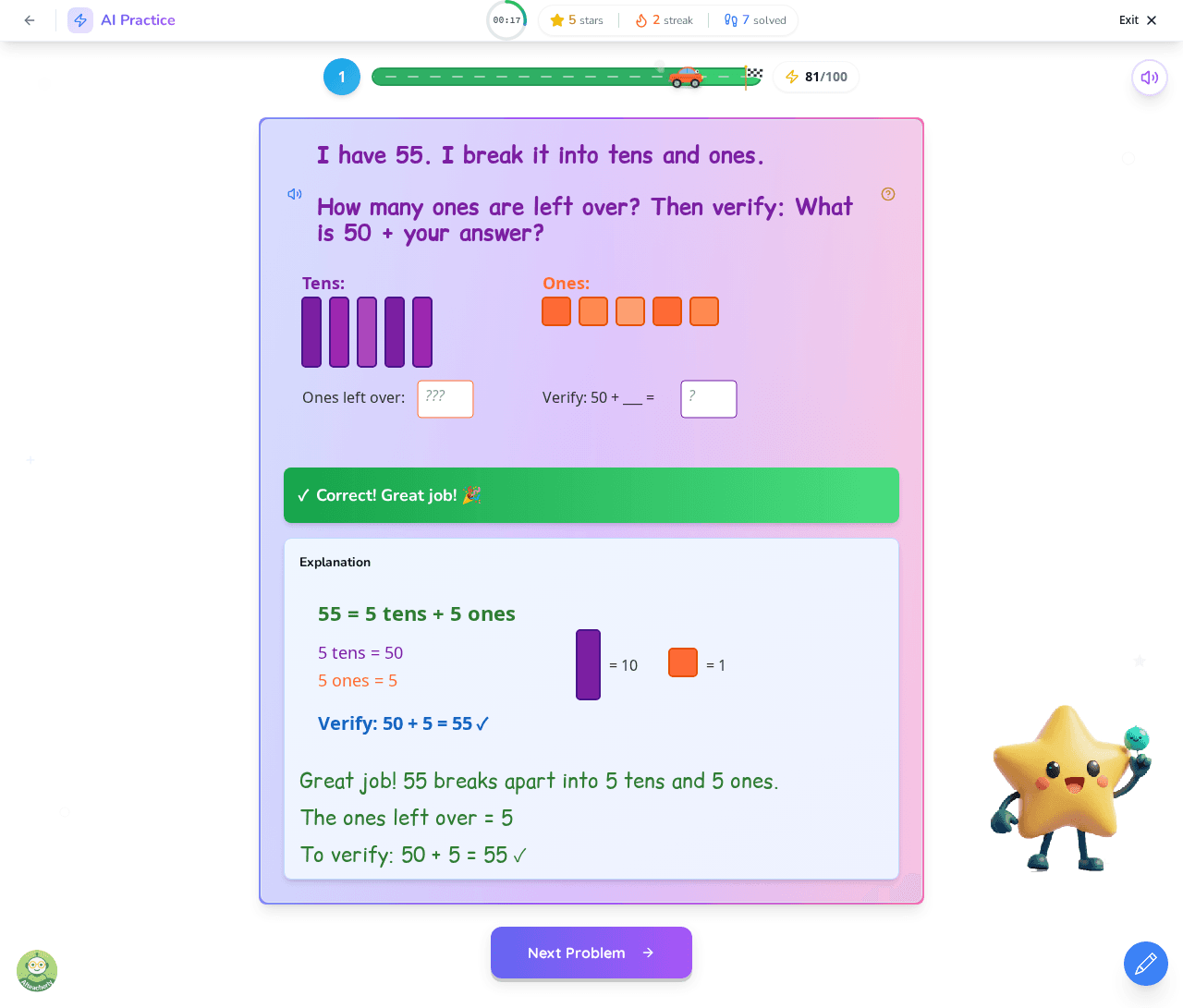
Why Place Value Is Your First Grader's Math Superpower
That moment when your first grader brings home math homework with "tens and ones" and you're not quite sure how to explain it? You're definitely not alone. Place value might sound like complicated math jargon, but it's actually one of the most important building blocks of your child's entire math education.
Understanding tens and ones is the foundation for everything that comes next: adding larger numbers, subtracting with borrowing, multiplication, and even understanding money. When kids truly grasp this concept in first grade, they build confidence that carries through their entire math journey.
The good news? Teaching tens and ones at home is easier than you might think, and you don't need fancy materials or a teaching degree to do it well. In this guide, you'll discover exactly what place value means for first graders, simple activities you can do together using household items, and how interactive digital tools can reinforce what they're learning in class.
Whether your child is just being introduced to two-digit numbers or needs extra practice, these strategies will help make place value concepts click. Let's turn those homework struggles into confidence-building moments!
What Are Tens and Ones in First Grade Math?
Place value is simply the idea that a digit's position in a number tells you its value. In first grade, children focus on understanding two-digit numbers (10-99) by learning that these numbers are made up of two parts: tens and ones.
Here's the simple rule that unlocks two-digit numbers: The left digit tells us how many groups of ten. The right digit tells us how many single units (ones).
For example, in the number 34:
- The 3 is in the "tens place" and represents 3 groups of ten (which equals 30)
- The 4 is in the "ones place" and represents 4 single units
- Together: 30 + 4 = 34
This is different from just counting to 34. Place value helps children understand why numbers are written the way they are and how our base-ten number system works. When your child sees the number 52, they're not just seeing "fifty-two" as a single thing; they're learning to see 5 tens (50) and 2 ones (2) working together.
Why does this matter? Understanding that the digit and its value are different is crucial. The digit 3 by itself is just three, but in the tens place, it has a value of 30. This foundational understanding prevents confusion when children later learn to add, subtract, and regroup larger numbers.
How to Explain Place Value to a 6-Year-Old
Young children learn best through concrete examples they can see and touch before moving to abstract numbers. Here's a simple, step-by-step approach to explaining tens and ones:
Step 1: Start with grouping
Gather 23 small objects (pennies, Legos, crackers, anything works). Ask your child to count them one by one. Then say, "Let's organize these better! Let's make groups of 10."
Help them create 2 groups of 10 with 3 left over. Point out: "We have 2 groups of ten and 3 extras. That's 23!"
Step 2: Introduce the vocabulary
Once they understand grouping, introduce the terms: "The groups of ten live in the tens place. The singles live in the ones place." Use a simple place value chart drawn on paper with two columns labeled "Tens" and "Ones."
Step 3: Practice both directions
Building numbers is important, but breaking them apart is equally valuable. Give your child a number like 45 and ask, "How many tens? How many ones?" Then reverse it: "I have 6 tens and 2 ones. What number did I make?"
Step 4: Make it visual
Use different colors or sizes to distinguish tens from ones. Blue blocks for tens, orange for ones; paper cups for tens, pebbles for ones. The visual difference helps cement the concept that tens and ones are different in size and value.
Simple Activities to Practice Tens and Ones at Home
You don't need expensive math manipulatives to practice place value. Here are engaging activities using items you already have:
The Snack Stack Game
Use small snacks like Cheerios or raisins. Give your child a two-digit number and have them "build" it using groups of 10 snacks (in small cups or on plates) and individual snacks. They can eat their creation after correctly building the number!
Coin Collection
Dimes are perfect for tens, and pennies work for ones. Give your child a pile of each and practice building numbers. "Can you show me 37 cents using dimes and pennies?" This doubles as early money skills!
Place Value Bowling
Set up 10 empty water bottles. After each roll, count how many fell and record it. After several rounds, add up the score by grouping fallen bottles into tens and ones.
Number Detective
Point out two-digit numbers in daily life (house numbers, page numbers, scores) and ask your child to identify the tens and ones. "Our house number is 47. How many tens? How many ones?"
The interactive problem below shows exactly how digital activities can reinforce these same concepts with colorful base-ten blocks:
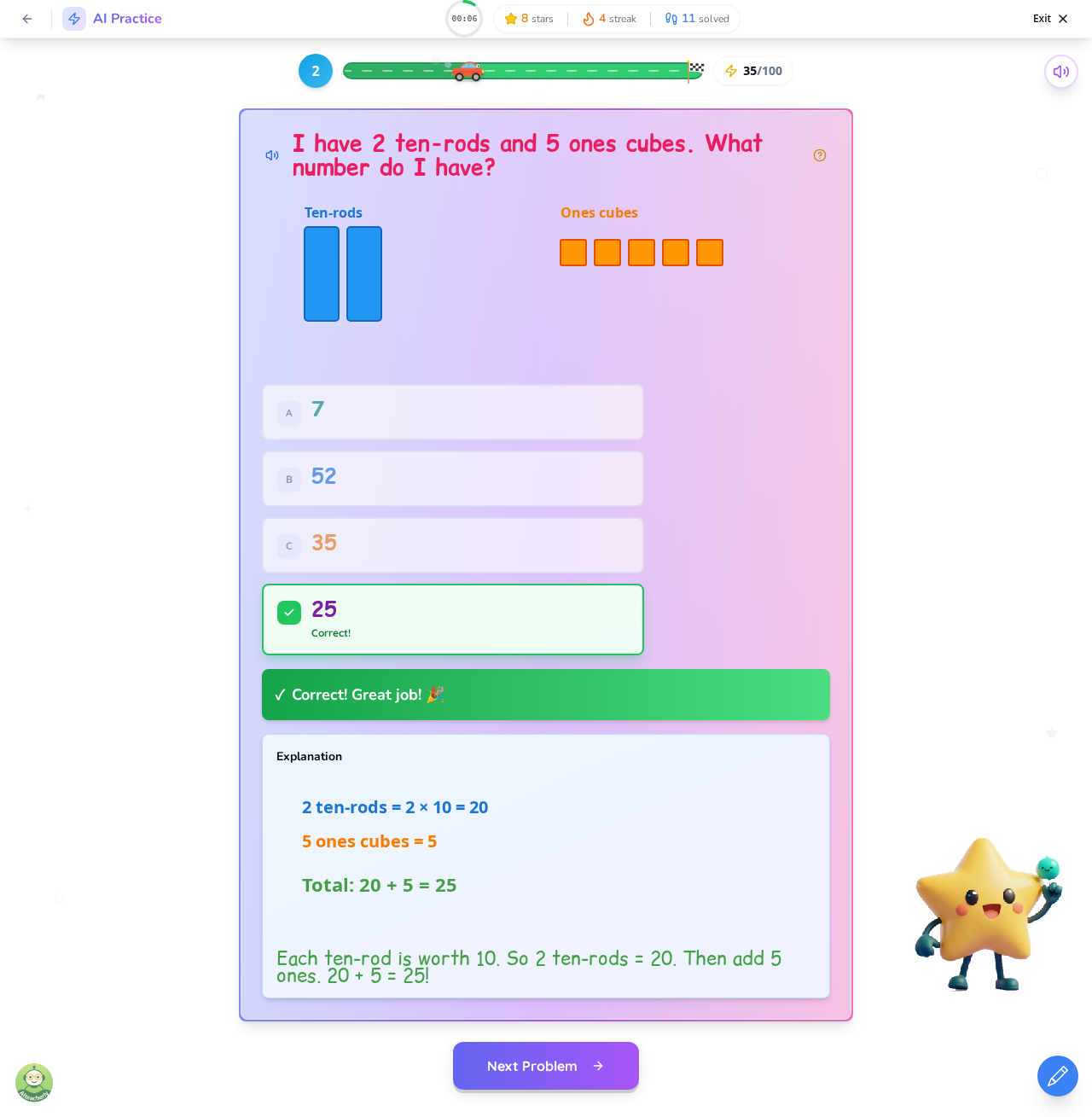
See How Interactive Learning Makes Place Value Click
While hands-on activities at home are wonderful, interactive digital tools offer something special: immediate feedback and guided instruction that builds on each correct answer.
In AI Teacherly's Understanding Tens and Ones lesson, first graders work through a carefully designed learning progression:
- Visual introduction using colorful base-ten blocks (blue for tens, orange for ones)
- Guided practice building numbers from tens and ones combinations
- Reverse thinking by breaking apart numbers to identify place values
- Real-world problems connecting place value to everyday scenarios
The lesson teaches children: "Watch the tens, then the ones. 3 tens is 30. Plus 4 ones. 30 plus 4 equals 34!" This narrated, step-by-step approach mirrors exactly how you might teach at home, but with engaging visuals and interactive elements that keep young learners motivated.
Here's what the full interactive lesson looks like on AI Teacherly:
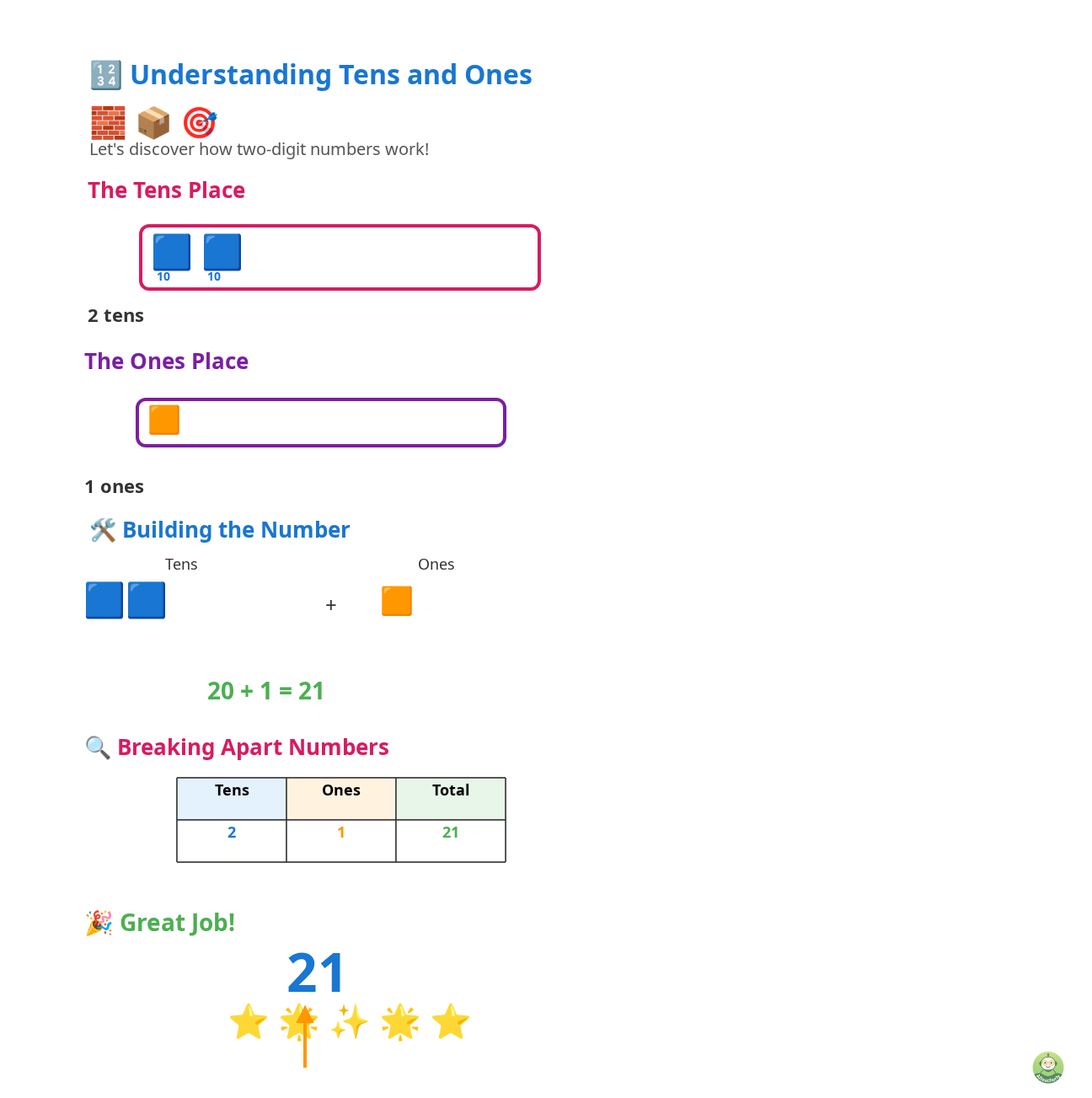
What makes interactive learning particularly effective is the variety of question types. Children build numbers, break them apart, and apply their understanding to word problems about real-world situations like counting marbles or organizing collections. This multi-angle approach ensures deep understanding rather than rote memorization.
Common Place Value Mistakes and How to Fix Them
Even with great instruction, children sometimes develop misconceptions about tens and ones. Here are the most common mistakes and how to address them:
Mistake 1: Confusing the digit with its value
When asked "What does the 5 mean in 52?" some children say "five" instead of "fifty" or "5 tens."
Fix: Emphasize the difference between the digit (5) and its value (50). Use physical objects: "This 5 means 5 groups of ten. Let's count them: 10, 20, 30, 40, 50!"
Mistake 2: Reversing tens and ones
Some children write 35 when they mean 53, or they put the ones digit first.
Fix: Use consistent left-to-right practice with place value charts. Create a memorable phrase: "Tens first, ones next" or "Big groups first, small groups second."
Mistake 3: Not understanding that 10 ones equals 1 ten
Children may not grasp that 10 singles can be "traded" for one group of ten.
Fix: Play trading games! When your child collects 10 pennies, trade them for a dime. When they have 10 small blocks, bundle them with a rubber band into one "ten."
Mistake 4: Thinking place value only applies to certain numbers
Some children don't realize that even single-digit numbers have place value (5 is really 0 tens and 5 ones).
Fix: Include single-digit numbers in your practice. Ask, "How many tens in the number 7?" (Zero!) This prepares them for addition with regrouping later.
Key Takeaways for Parents
Teaching tens and ones to your first grader doesn't require special training or expensive materials. Here's what to remember:
Place value is foundational. Understanding tens and ones now prevents math struggles with addition, subtraction, and multiplication later.
Start concrete, then go abstract. Use physical objects (coins, blocks, snacks) before moving to written numbers and worksheets.
Practice both directions. Building numbers (3 tens + 4 ones = 34) AND breaking them apart (34 = 3 tens + 4 ones) reinforces understanding.
The digit is not the value. Help your child understand that the 5 in 52 represents 50, not 5.
Make it daily. Point out two-digit numbers in everyday life: addresses, page numbers, prices, and scores.
Combine hands-on and digital practice. Physical activities build understanding; interactive lessons provide guided practice and immediate feedback.
Be patient with mistakes. Reversing digits or confusing tens and ones is normal. Gentle correction and consistent practice will build confidence.
Remember, every math expert started exactly where your first grader is now. With your support and these strategies, place value will become second nature for your child.
Key Takeaways
- Place value is the foundation for all future math skills including addition, subtraction, and multiplication with larger numbers
- Use concrete objects first (coins, blocks, snacks) before moving to abstract written numbers
- Practice both building numbers and breaking them apart to reinforce understanding from multiple angles
- The digit and its value are different: the 5 in 52 represents 50, not 5
- Interactive digital tools provide guided practice with immediate feedback that builds confidence
- Point out two-digit numbers in everyday life to make place value relevant and practical
- Be patient with common mistakes like reversing digits; consistent practice builds mastery
Frequently Asked Questions
What are tens and ones in first grade math?
Tens and ones are place value positions in two-digit numbers. The left digit shows how many groups of ten, and the right digit shows single units. For example, 47 has 4 tens (40) and 7 ones.
How do I explain place value to a 6-year-old?
Start with physical objects like coins or blocks. Group items into sets of 10 and show that 23 means 2 groups of ten plus 3 extras. Use a simple two-column chart labeled Tens and Ones.
What household items can I use to teach tens and ones?
Pennies and dimes work perfectly (dimes for tens, pennies for ones). You can also use Legos, small snacks, buttons, or any small objects that can be grouped into sets of 10.
Why does my child struggle with place value?
Many children confuse the digit with its value (thinking the 5 in 52 means 5, not 50). Using physical manipulatives and practicing both building and breaking apart numbers helps overcome this confusion.
When should first graders understand tens and ones?
Most first graders are introduced to place value during fall or winter of the school year. By the end of first grade, children should comfortably work with two-digit numbers up to 99.
Are base ten blocks necessary for teaching place value?
No, you can use household substitutes like coins (dimes and pennies), bundled straws, small snacks in cups, or any objects that can represent groups of 10 and singles.
How do I know if my child understands place value?
Ask them to build a number using objects and explain their thinking. If they can say "34 is 3 tens and 4 ones" and show it with manipulatives, they understand the concept.
Ready to make place value practice fun and effective? Try the interactive Understanding Tens and Ones lesson free on AI Teacherly and watch your first grader's confidence grow!