Two-Digit Subtraction with Regrouping Made Easy: A Parent's Complete Guide to Teaching Borrowing
That moment when your 2nd grader freezes at a subtraction problem because "you can't take 7 from 3" is more common than you think. Learn the simple trading trick that makes regrouping click!
Why Regrouping Trips Up So Many 2nd Graders
That moment when your child stares at a subtraction problem and freezes because "you can't take 7 from 3" is one of the most common struggles in second grade math. You're not alone if homework time has turned into a battle over these problems.
Subtraction with regrouping in 2nd grade is a major milestone, but it trips up most children for a simple reason: they see it as a mysterious rule rather than a logical process. Teachers might say "borrow from the tens," but what does that actually mean to a 7-year-old?
The good news? Once your child understands that regrouping is just trading, not magic, it clicks fast. Think of it like breaking a $10 bill into ten $1 bills. You still have the same amount of money; it's just arranged differently.
In this guide, you'll learn exactly how to explain two-digit subtraction with borrowing in a way that makes sense to your 2nd grader. We'll cover when regrouping is needed, walk through the steps, and show you how interactive practice can build lasting confidence.
What Is Regrouping in Subtraction (And Why Do We Call It Borrowing)?
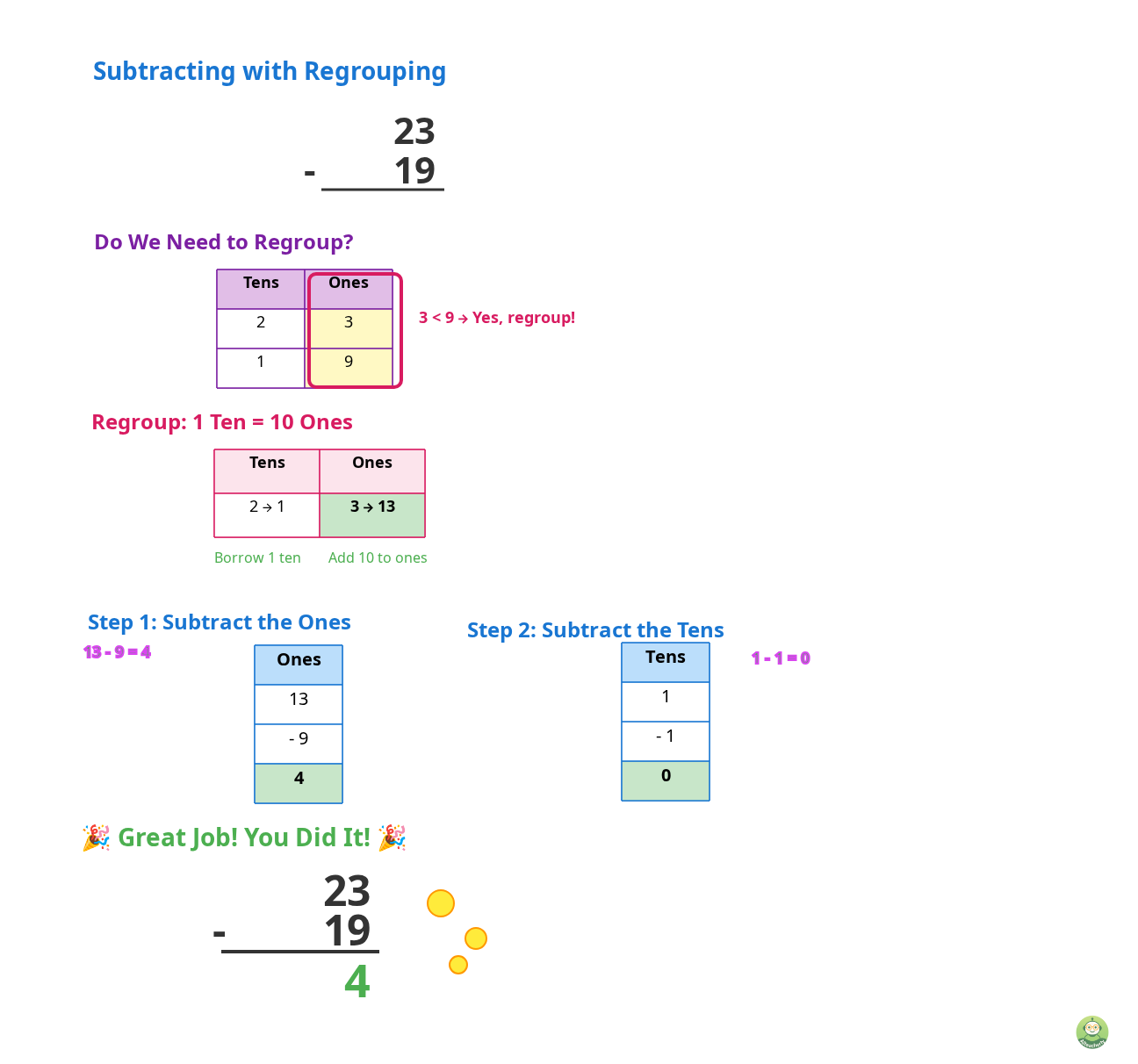
Regrouping is the process of breaking apart a number to make subtraction possible. When we can't subtract the ones column because the top digit is smaller than the bottom digit, we "regroup" by taking 1 ten and converting it into 10 ones.
You might have grown up calling this "borrowing." Both terms describe the same thing, and your child's teacher might use either one. The key difference is in the mindset:
- Borrowing sounds like you're taking something that needs to be returned (it doesn't!)
- Regrouping or trading emphasizes that you're rearranging the same number in a different form
Here's a concrete example your child can understand:
Imagine you have 3 full bags of 10 marbles each, plus 2 loose marbles (that's 32 marbles total). If you need to give away 5 marbles, you don't have enough loose ones. So you open one bag (now you have 2 bags) and pour those 10 marbles with your loose ones (now you have 12 loose marbles). You still have 32 marbles total; they're just arranged differently, and now you can give away 5!
This "trading" mindset is the foundation of understanding regrouping in subtraction. When your child sees the tens digit decrease and the ones digit increase, they'll understand why it happens, not just memorize that it does.
How Do You Know When to Regroup?
Before your child can subtract, they need to recognize when regrouping is necessary. This is actually a simple skill once they know what to look for.
The Rule: Compare the digits in the ones column. If the top number is smaller than the bottom number, you need to regroup.
Let's look at examples:
43 - 21 (No regrouping needed)
- Look at the ones: 3 and 1
- Is 3 smaller than 1? No!
- We can subtract 1 from 3, so no regrouping needed
43 - 27 (Regrouping IS needed)
- Look at the ones: 3 and 7
- Is 3 smaller than 7? Yes!
- We cannot subtract 7 from 3, so we must regroup
Practice questions to ask your child:
- "Look at the ones column. Can we do that subtraction?"
- "Is the top number big enough to take away the bottom number?"
- "Do we need to get more ones from the tens?"
This quick check becomes automatic with practice. Encourage your child to always look at the ones column first and ask themselves: "Can I do this, or do I need to regroup?"
Step-by-Step: How to Subtract Two-Digit Numbers with Regrouping
Now let's walk through the complete process. Once your child knows these steps, they can tackle any two-digit subtraction problem with regrouping.
Step 1: Line Up the Numbers Write the larger number on top and the smaller number below it. Make sure tens are above tens and ones are above ones.
Step 2: Check the Ones Column Ask: "Can I subtract the bottom from the top?" If the top digit is smaller, proceed to regrouping.
Step 3: Regroup (Trade 1 Ten for 10 Ones)
- Cross out the tens digit and write a number that's 1 less
- Add 10 to the ones digit (write the new number next to it)
Step 4: Subtract the Ones Column Now you can subtract because you have enough ones!
Step 5: Subtract the Tens Column Use the new (smaller) tens digit.
The interactive problem below shows exactly how this regrouping process works with visual place value blocks:
Example: 52 - 27
- Look at ones: 2 - 7? Can't do it!
- Regroup: Take 1 from the 5 (now 4), add 10 to the 2 (now 12)
- Subtract ones: 12 - 7 = 5
- Subtract tens: 4 - 2 = 2
- Answer: 25
The key reminder for your child: "We use the smaller tens number because we traded one away!"
See Regrouping in Action on AI Teacherly
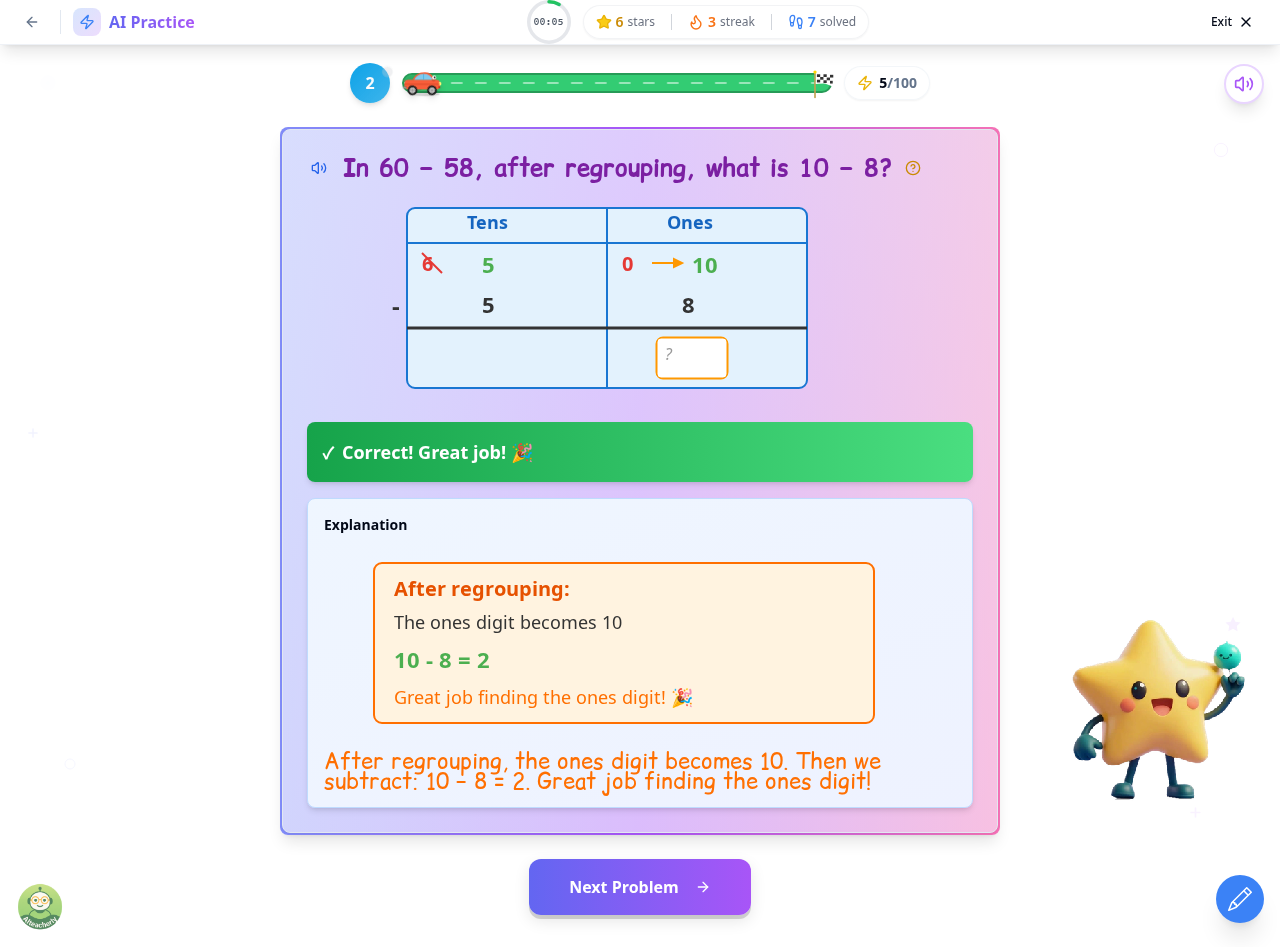
Reading about regrouping is helpful, but nothing beats seeing it in action with interactive visuals. That's where AI Teacherly's Subtract Two-Digit Numbers with Regrouping lesson shines.
Here's what the full interactive lesson experience looks like:
In this Grade 2 lesson, students don't just solve problems; they watch the regrouping happen. The lesson walks through each step with clear narration:
- "Look at the ones column. Can we do that? No! The top number is smaller than the bottom. That means we need to regroup!"
- "Here's the trick! We take 1 ten and turn it into 10 ones."
- "Watch! The tens digit becomes smaller, and the ones digit gets 10 more. That's regrouping!"
The visual transformation, seeing 1 ten block break into 10 ones blocks, creates the "aha moment" that worksheets simply can't provide. Your child sees why the numbers change, not just that they do.
What makes interactive practice different:
- Immediate feedback when something goes wrong
- Visual manipulatives that show place value
- Step-by-step guidance that mirrors how you'd teach at home
- Engaging format that feels less like homework
Whether your child needs extra practice or just a different way to see the concept, interactive lessons can bridge the gap between confusion and confidence.
Common Mistakes Kids Make with Borrowing (And How to Fix Them)
Even after learning the steps, most 2nd graders make predictable mistakes with regrouping. Knowing what to watch for helps you catch and correct errors quickly.
Mistake #1: Forgetting to Reduce the Tens Digit Your child borrows 10 ones but forgets to cross out and reduce the tens digit. The answer ends up way too big.
Fix: Have them always cross out the old tens digit immediately after borrowing. Say: "You took one away, so write the new number right now!"
Mistake #2: Subtracting the Smaller from the Larger (Wrong Direction) In 43 - 27, they might subtract 3 from 7 in the ones column (getting 4) instead of regrouping.
Fix: Always ask: "Which number is on TOP? We subtract FROM the top number."
Mistake #3: Regrouping When It's Not Needed Some kids get so used to regrouping that they do it for every problem, even when it's unnecessary.
Fix: Make the ones column check a consistent first step. Ask: "Do we NEED to regroup, or can we just subtract?"
Mistake #4: Adding Instead of Subtracting After Regrouping The flurry of crossing out and writing new numbers confuses them about what operation they're doing.
Fix: After regrouping, pause and say: "Okay, now we're ready to SUBTRACT." Refocus on the subtraction operation.
Patience is key. These mistakes are normal and disappear with practice!
Fun Ways to Practice Regrouping at Home
Worksheets have their place, but varied practice keeps your child engaged and builds deeper understanding. Here are hands-on ways to reinforce regrouping:
1. The Money Game Use real or play money. Give your child $52 (five $10 bills and two $1 bills). Ask them to "spend" $27. They'll naturally need to break a $10 bill into ones. This is regrouping in action!
2. Base-Ten Block Play If you have base-ten blocks (or can print paper versions), let your child physically trade a tens rod for 10 unit cubes. The tactile experience reinforces the concept beautifully.
3. Sticker or Candy Math Use small objects in groups of 10 (stickers on sheets, candies in rolls). Pose subtraction problems and let your child "open" a pack of 10 when needed.
4. "Spot the Regroup" Challenge Write 10 subtraction problems on paper. Challenge your child to sort them into two piles: "needs regrouping" and "no regrouping." This builds the recognition skill without the pressure of solving.
5. Interactive Online Practice Platforms like AI Teacherly offer visual, game-like subtraction lessons that provide instant feedback. Short 10-15 minute sessions can be more effective than lengthy worksheet drills.
The key to success: Keep practice sessions short (15-20 minutes), positive, and consistent. A few problems each day beats marathon sessions that lead to frustration.
Key Takeaways
- Regrouping is trading, not magic: 1 ten becomes 10 ones, but the total stays the same
- Always check the ones column first: if the top digit is smaller than the bottom, you need to regroup
- Reduce the tens digit immediately after borrowing to avoid the most common mistake
- Use concrete objects like money or blocks to make the concept tangible for your child
- Short, consistent practice sessions work better than long, frustrating ones
- Interactive lessons with visual manipulatives can create the 'aha moment' that worksheets miss
Frequently Asked Questions
What is regrouping in 2nd grade math and is it the same as borrowing?
Yes! Regrouping and borrowing are the same thing. It means breaking apart 1 ten into 10 ones so you can subtract when the ones digit on top is too small. Regrouping is the preferred term because it emphasizes trading, not taking.
How do I know when my child needs to regroup in subtraction?
Look at the ones column. If the top digit is smaller than the bottom digit (like 3 minus 7), regrouping is needed. If the top digit is equal to or larger than the bottom, no regrouping is necessary.
Why does my child keep forgetting to reduce the tens digit after borrowing?
This is the most common regrouping mistake! Have your child cross out the old tens digit immediately after borrowing, before doing anything else. Making it an automatic first step prevents forgetting.
Is it normal for 2nd graders to struggle with subtraction regrouping?
Absolutely normal. Regrouping requires understanding place value, multi-step processes, and careful tracking of changes. Most children need repeated practice and different explanations before it clicks.
What's the easiest way to explain borrowing to a 7-year-old?
Use money! Show your child 3 ten-dollar bills and 2 ones. Ask them to give you $7. They'll realize they need to break a $10 bill into ones. That's regrouping in real life.
When should my child have mastered subtraction with regrouping?
Most curricula expect fluency with two-digit subtraction regrouping by the end of 2nd grade. However, every child develops at their own pace. Consistent practice matters more than hitting a specific deadline.
How can I practice regrouping without boring worksheets?
Try hands-on activities like money games, base-ten blocks, or sorting problems into 'needs regrouping' and 'no regrouping' piles. Interactive online lessons with visual manipulatives also make practice more engaging.
Should I say 'borrowing' or 'regrouping' when helping my child?
Use whatever term your child's teacher uses for consistency. If you have a choice, 'regrouping' or 'trading' better describes what's happening: you're rearranging the number, not borrowing something that needs returning.
Ready to make subtraction with regrouping click for your 2nd grader? Try the interactive Subtract Two-Digit Numbers with Regrouping lesson free on AI Teacherly. Watch your child's confusion turn into confidence with visual, step-by-step practice!