Two-Step Word Problems Made Easy: The Hidden Question Method for 3rd Grade Success
Discover the hidden question method that transforms confusing two-step word problems into simple, manageable steps for your 3rd grader.
When Word Problems Leave Your Child Staring at the Page
You've seen it happen. Your third grader opens their math homework, reads a word problem, and freezes. "I don't get it," they say, their pencil hovering over a blank page. The frustrating part? You know they can add, subtract, multiply, and divide just fine. So why does this particular problem feel impossible?
Here's the secret that changes everything: two-step word problems aren't harder math. They're two simple problems disguised as one. The challenge isn't the calculations; it's knowing where to start.
Two-step word problems mark a major milestone in 3rd grade mathematics. They require students to identify multiple operations, solve them in the correct order, and combine the results. This shift from single-operation problems to multi-step thinking trips up many children, but it doesn't have to trip up yours.
In this guide, you'll discover a simple strategy called the hidden question method that transforms overwhelming problems into clear, manageable steps. No math degree required. Just a few minutes of practice can unlock your child's confidence and make homework time smoother for everyone.
What Are Two-Step Word Problems and Why Do They Trip Kids Up?
A two-step word problem is exactly what it sounds like: a math problem that requires two separate calculations to solve. Instead of asking one question with one operation, these problems ask a final question that can only be answered after solving something else first.
Here's a simple example:
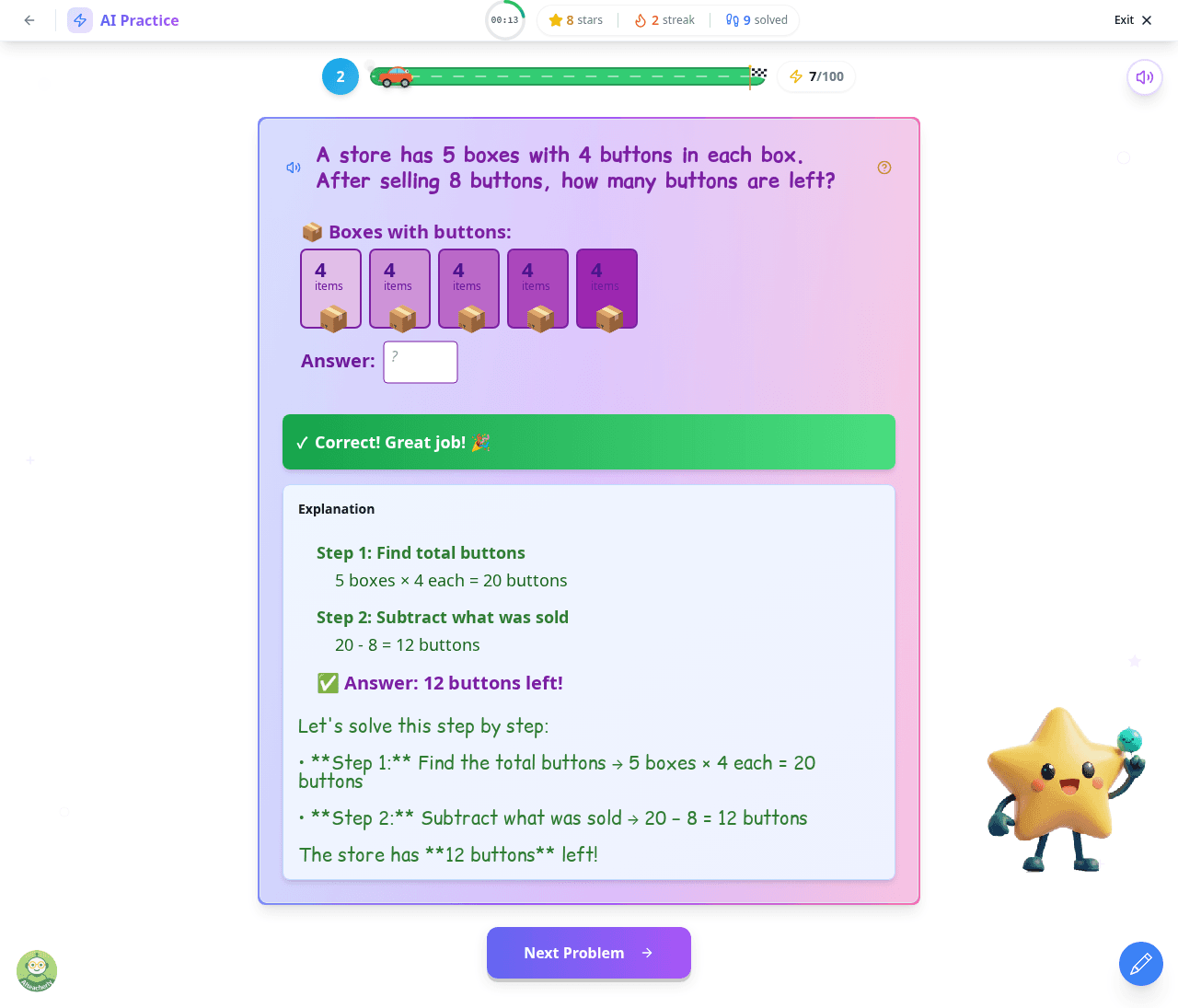
Emma has 3 bags with 4 apples in each bag. Her friend gives her 5 more apples. How many apples does Emma have in total?
To answer "How many apples in total?" your child first needs to figure out how many apples were in the bags (3 × 4 = 12). Only then can they add the 5 extra apples (12 + 5 = 17).
Why do these problems feel so hard?
The biggest challenge isn't the math itself. It's that the "hidden question" (How many apples were in the bags?) isn't directly asked. Your child must discover it themselves.
Think of it like a treasure hunt. The final answer is the treasure, but there's a locked door in the way. The hidden question is the key. Without finding that key first, your child can't reach the treasure, no matter how good they are at math.
Common operations in 3rd grade two-step problems include:
- Addition + Subtraction: "Some arrived, then some left"
- Multiplication + Addition: "Groups of items, then more added"
- Multiplication + Subtraction: "Groups of items, then some removed"
- Division + Addition/Subtraction: "Sharing equally, then adjusting"
Once your child learns to spot the hidden question, these problems transform from confusing to conquerable.
The Hidden Question Method: Your Child's New Secret Weapon
The hidden question method is a simple, three-step strategy that works for virtually any two-step word problem. Teach this to your child, and watch their confidence soar.
Step 1: Read and Identify the Final Question
Have your child read the entire problem first, then find the final question being asked. This is usually at the end. In our apple example, the final question is: "How many apples does Emma have in total?"
Step 2: Find the Hidden Question
This is the game-changer. Ask your child: "What do we need to figure out FIRST before we can answer the final question?"
In the apple problem, we can't find the total until we know how many apples were in the bags. That's the hidden question: "How many apples are in 3 bags with 4 apples each?"
Teach your child to look for clues:
- Are there groups that need counting? (multiplication)
- Is something being shared equally? (division)
- Are quantities changing? (addition or subtraction)
Step 3: Solve Step-by-Step and Check
Once both questions are identified, solve them in order:
- Step 1: 3 bags × 4 apples = 12 apples in bags
- Step 2: 12 apples + 5 more = 17 apples total
The reasonableness check: Always ask, "Does this make sense?" Emma started with bags of apples and got MORE apples. Should her total be bigger or smaller? Bigger! And 17 is bigger than 12, so we're on the right track.
This final check catches careless errors and builds number sense, a skill that pays dividends throughout your child's math education.
How to Practice Two-Step Problems at Home (Without the Tears)
Practicing two-step word problems doesn't have to mean worksheets and frustration. Here are parent-tested strategies that make practice feel like play.
Use Real-Life Scenarios
Turn everyday moments into two-step problems:
- "We have 3 shelves with 5 books each. If we donate 4 books, how many will we have?"
- "You have 20 minutes before bed. If you spend 8 minutes brushing your teeth and 5 minutes picking out clothes, how much reading time is left?"
- "We need 24 cookies for the party. If each tray holds 6 cookies, and we already have 12 baked, how many more trays do we need?"
Real-world context helps children see WHY finding the hidden question matters.
The "Think Aloud" Technique
When working through problems together, model your thinking out loud:
- "Hmm, they're asking how many total. But wait, I don't know how many are in the boxes yet. That's my hidden question!"
- "Let me solve that first... okay, now I can answer the real question."
This shows your child that even adults follow a process.
Visual Tools That Work
Draw simple boxes or circles to represent each step. Label them "Step 1" and "Step 2." This visual separation helps children see that two-step problems are really just two one-step problems connected together.
The interactive problem below shows exactly how visual elements help children work through classroom scenarios step-by-step:
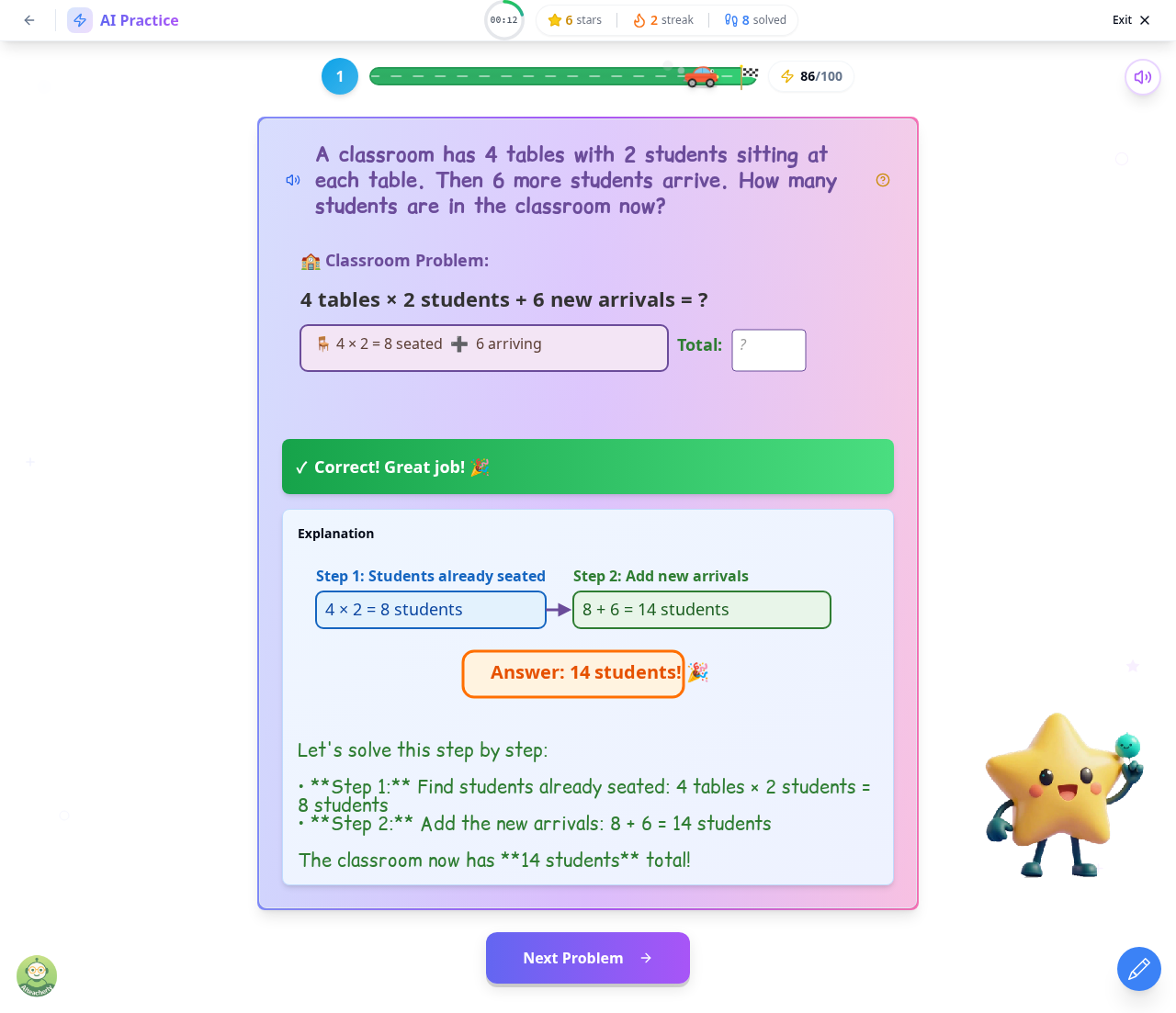
See Two-Step Problems in Action on AI Teacherly
Sometimes the best way to understand a concept is to see it in action. AI Teacherly's interactive lessons bring two-step word problems to life with visual manipulatives, step-by-step guidance, and immediate feedback.
In the Two-Step Word Problems lesson designed for 3rd graders, students discover the hidden question concept through engaging scenarios like party planning, classroom setups, and library book counting. Each problem uses colorful visual shapes that make abstract math concrete and tangible.
Here's what the full interactive lesson looks like on AI Teacherly:
What makes interactive practice different from worksheets?
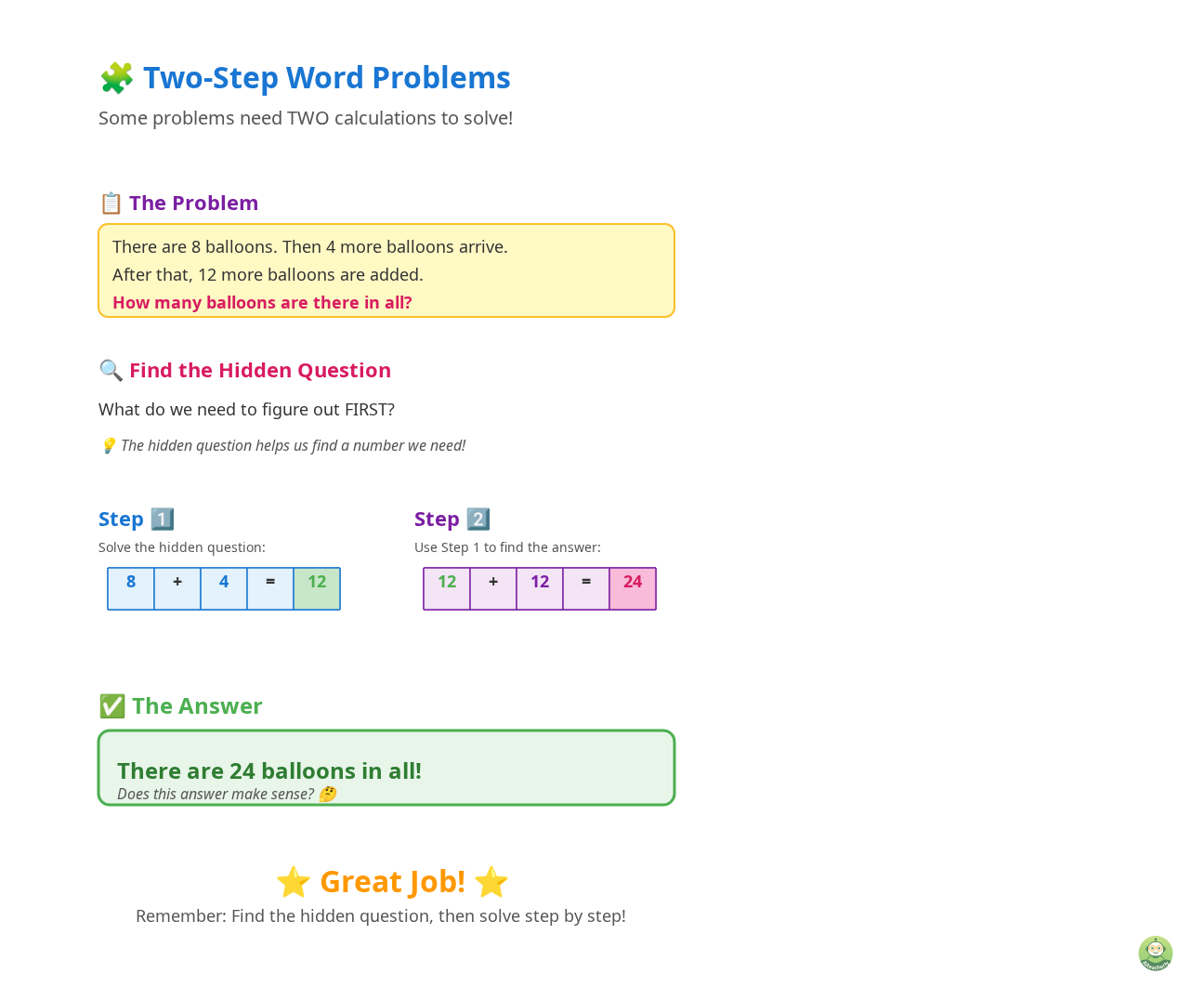
Guided Discovery: Instead of just being told the answer, students uncover the hidden question themselves through carefully designed prompts. The lesson teaches: "Two-step problems have a hidden question. It's something we need to figure out first before we can answer the main question. Look for what's missing. That's your hidden question!"
Visual Representations: Problems include shapes, arrays, and models that help children "see" the math. A problem about 3 tables with 4 students each isn't just numbers; it's a visual classroom they can count.
Instant Feedback: Children know immediately whether they're on the right track, which builds confidence and prevents practicing mistakes.
The Reasonableness Check: The lesson reinforces checking answers: "Does that make sense? We started with some, then more arrived, then more were added. We kept adding more, so our total got bigger!"
This combination of visual learning, guided practice, and immediate feedback helps children internalize the hidden question strategy until it becomes second nature.
Common Mistakes to Watch For and How to Fix Them
Knowing the most common pitfalls helps you guide your child more effectively. Here's what to watch for:
Mistake #1: Jumping to the Final Question
The most frequent error is skipping the hidden question entirely. Your child sees "How many total?" and immediately starts adding or multiplying whatever numbers they see.
The fix: Before any calculating, have your child identify BOTH questions by circling the final question and underlining the hidden question in the problem.
Mistake #2: Using the Wrong Operations
Keyword confusion causes trouble. "More" usually means addition, but "5 more bags" in a multiplication context means something different than "5 more apples."
The fix: Instead of relying on keywords, teach your child to visualize the story. "What's happening? Are we putting groups together? Taking some away? Sharing equally?" The action in the story determines the operation.
Mistake #3: Forgetting to Use Step 1's Answer
Some children solve the hidden question correctly, then forget to use that answer in Step 2. They might write "12" and then start a completely new calculation.
The fix: Have your child draw an arrow from their Step 1 answer to Step 2's equation, showing the connection visually.
Mistake #4: Not Checking Reasonableness
If a problem describes someone GAINING items but the answer is smaller than what they started with, something went wrong.
The fix: Make "Does this make sense?" a required final step. Ask guiding questions: "Did the number get bigger or smaller? Should it have?" This habit catches errors and builds mathematical intuition.
Mistake #5: Rushing Through Reading
Word problems require careful reading. Skimming leads to missed details and wrong answers.
The fix: Encourage your child to read the problem twice: once to understand the story, and once to identify the questions and numbers.
Key Takeaways for Two-Step Word Problem Success
Let's recap the essential strategies that will help your third grader master two-step word problems:
Two-step problems are two simple problems in one. The challenge isn't harder math; it's finding where to start.
The hidden question is the key. Teach your child to ask, "What do I need to figure out FIRST before I can answer the final question?"
Real-life practice works best. Use shopping trips, cooking, and everyday scenarios to make two-step thinking natural.
Visual strategies help. Drawing boxes for Step 1 and Step 2 makes the process concrete and clear.
Always check for reasonableness. "Does my answer make sense given what happened in the story?" catches careless errors.
Patience beats pressure. Two-step problems are a big cognitive leap. Celebrate progress, not just correct answers.
Interactive practice builds confidence. Tools like AI Teacherly provide the guided, visual practice that helps strategies stick.
Remember, every child who struggles with two-step problems today can master them with the right approach. The hidden question method gives your child a reliable strategy they can use every single time, turning "I don't get it" into "I've got this."
Key Takeaways
- Two-step word problems are simply two single-step problems combined; the challenge is finding where to start, not doing harder math
- The hidden question method teaches children to identify what they must solve FIRST before answering the final question
- Real-life scenarios like shopping, cooking, and sharing make two-step problem practice engaging and meaningful
- Visual strategies such as drawing labeled boxes for Step 1 and Step 2 help children see problems as manageable pieces
- The reasonableness check ('Does this make sense?') catches careless errors and builds long-term number sense
- Common mistakes include skipping the hidden question and forgetting to use Step 1's answer in Step 2
- Interactive lessons with visual manipulatives and immediate feedback help the hidden question strategy become second nature
Frequently Asked Questions
What is a two-step word problem in 3rd grade math?
A two-step word problem requires two separate calculations to solve. Students must first answer a 'hidden question' before they can solve the final question being asked. Common combinations include multiplication followed by addition or subtraction.
How do I teach my child to find the hidden question in word problems?
Have your child read the final question first, then ask: 'What do we need to figure out BEFORE we can answer this?' The hidden question is usually the calculation needed to get information for the final step. Look for groups, sharing, or quantities that need combining.
Why does my child struggle with word problems but not regular math?
Word problems require reading comprehension plus math skills simultaneously. Children must identify what's being asked, determine the correct operations, and sequence steps properly. The math itself isn't harder; the challenge is knowing where to start.
What are the most common mistakes kids make with two-step problems?
The top mistakes are: jumping straight to the final question without solving the hidden question first, using the wrong operations due to keyword confusion, and forgetting to use Step 1's answer in Step 2. Teaching the hidden question method prevents all three.
Should my child write out both steps or solve two-step problems in their head?
For 3rd graders learning this skill, always write out both steps. Label them 'Step 1' and 'Step 2' clearly. This builds good habits and helps catch errors. Mental math can come later once the strategy is automatic.
How do I know if my child's answer to a word problem is reasonable?
Ask whether the answer makes sense given the story. If items were added, the total should be larger. If items were removed or shared, it should be smaller. This 'reasonableness check' catches calculation errors and builds number sense.
What operations do 3rd graders use in two-step word problems?
Third graders typically see combinations of addition, subtraction, multiplication, and sometimes division. Common patterns include: multiplication then addition (groups plus extra), multiplication then subtraction (groups minus some), and addition with subtraction.
How much time should my child spend on each word problem?
Quality matters more than speed. Allow 3-5 minutes per problem when learning. Rushing leads to missed details and skipped steps. As the hidden question strategy becomes automatic, solving time will naturally decrease.
Ready to see the hidden question method in action? Try AI Teacherly's interactive Two-Step Word Problems lesson free and watch your child's confidence grow with every problem they solve!