Visual Subtraction for 2nd Graders: Why the Crossing Out Method Works Better Than Memorization
Discover why the crossing out method helps 2nd graders truly understand subtraction. Learn visual strategies, at-home activities, and see interactive lessons that make math click.
Why Visual Subtraction Changes Everything for 2nd Graders
Watching your 2nd grader struggle with subtraction worksheets can feel frustrating, especially when you know they're a bright kid. The problem often isn't their ability; it's the approach. Abstract math concepts like "take away" don't make sense to 7-year-olds whose brains are still developing concrete thinking skills.
This is exactly where visual subtraction for 2nd graders becomes a game-changer. Instead of asking children to manipulate invisible numbers in their heads, visual methods let them see, touch, and physically interact with the math problem. Research consistently shows that concrete, hands-on learning builds stronger mathematical foundations than rote memorization ever could.
The crossing out method is one of the most effective visual subtraction strategies because it mirrors how children naturally think about "taking away." When your child crosses out three apples from a group of seven, they're not just getting an answer; they're building genuine number sense that will serve them for years to come.
In this guide, you'll learn exactly what the crossing out method is, why it works so well for 2nd graders, and how to practice it at home using everyday objects. Plus, we'll show you interactive lessons that make this learning engaging and fun.
What Is the Crossing Out Method for Subtraction?
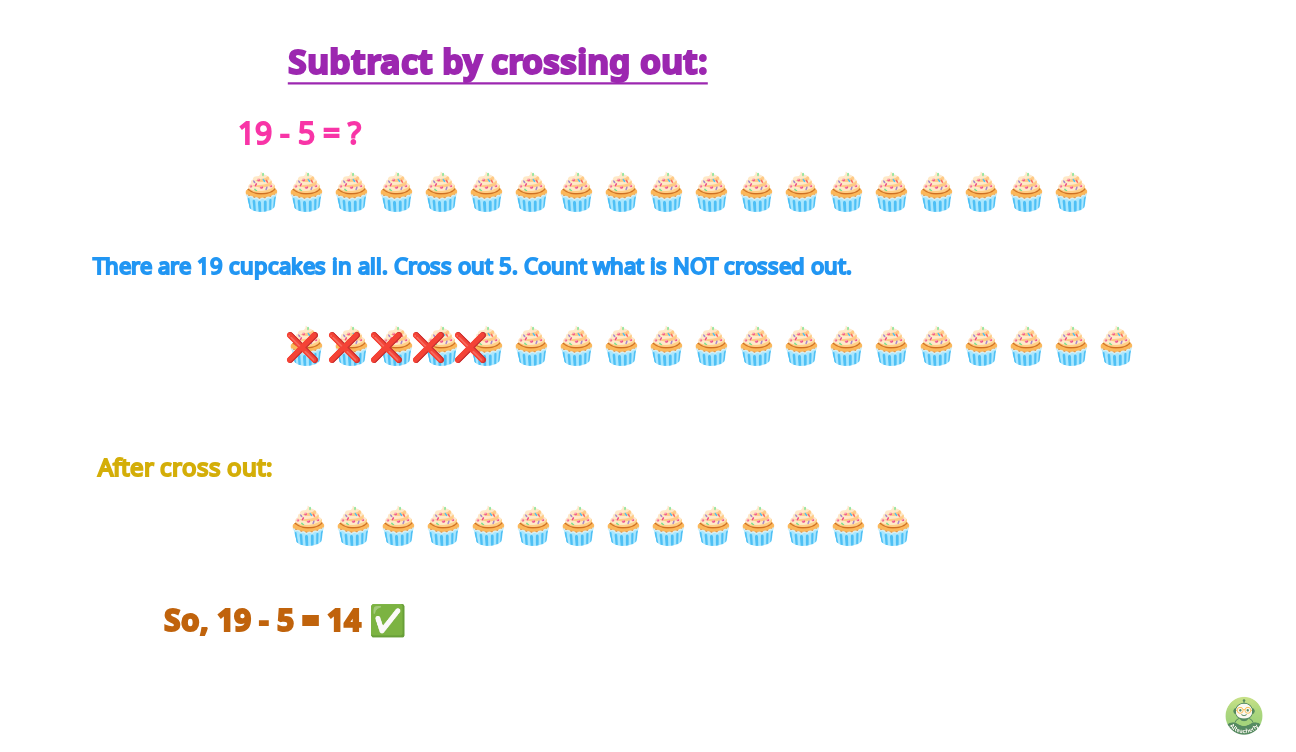
The crossing out method is a visual subtraction strategy where students draw or look at a group of objects, then physically cross out (or remove) the number being subtracted. The answer is simply what remains: the objects that are NOT crossed out.
Here's how it works in practice:
- Start with the total: Draw or gather the first number in objects (circles, dots, stars, or real items)
- Cross out the subtracted amount: Mark an X through the second number's worth of objects
- Count what's left: The remaining un-crossed objects give you the answer
For example, to solve 8 - 3:
- Draw 8 circles
- Cross out 3 of them with X marks
- Count the remaining 5 circles
- The answer is 5!
This method transforms the abstract equation "8 - 3 = ?" into a concrete, visual story: "We have 8 things. We crossed out 3. Now we have 5 left." This narrative approach connects directly to how children understand the world around them.
The beauty of the crossing out method is its simplicity. Your child doesn't need special materials or advanced instruction. Any objects, from cheerios to toy cars, can become subtraction manipulatives.
Why Do 2nd Graders Need Visual Subtraction Strategies?
At age 7, children are in what developmental psychologists call the "concrete operational stage." This means they learn best through tangible, hands-on experiences rather than abstract symbols and rules. Asking a 2nd grader to subtract mentally is like asking them to run before they can walk.
Visual subtraction strategies matter because they:
- Build number sense: Children develop an intuitive understanding of quantity relationships, not just memorized facts
- Prevent future struggles: Students who understand WHY subtraction works rarely struggle with regrouping (borrowing) later
- Reduce math anxiety: Visual methods feel achievable, turning "I can't do this" into "I got this!"
- Transfer to real life: Kids connect math to actual situations, like sharing snacks or counting toys
Many parents worry that using pictures or objects is a "crutch" that will hold their child back. The opposite is true. Visual strategies build the conceptual foundation that eventually makes mental math possible. Children who skip this stage often memorize answers without understanding, which causes problems when math gets more complex.
Think of it like learning to read. Children start with picture books, move to easy readers, and eventually read novels. Nobody worries that picture books will prevent reading. The same logic applies to visual math: it's a necessary developmental step, not a limitation.
How to Teach Crossing Out Subtraction at Home (Step-by-Step)
Teaching the crossing out method at home is simpler than you might think. You don't need to be a math expert; you just need patience and some everyday objects. Here's a step-by-step approach that works:
Step 1: Start with Real Objects Gather 10-15 small items (cereal pieces, buttons, LEGO bricks, or coins). Let your child touch and count them.
Step 2: Pose a Simple Problem Say something like: "We have 6 crackers. If we eat 2, how many are left?" Keep numbers small at first (within 10).
Step 3: Model the Crossing Out Process Show your child how to physically remove (or cover) 2 crackers, then count what remains. Use language like: "We started with 6. We took away 2. Let's count what's left: 1, 2, 3, 4! Four crackers are left."
Step 4: Move to Paper Once comfortable with objects, transition to drawing. Have your child draw circles, cross out the subtracted amount, and count the rest.
Step 5: Connect to Equations Finally, show how the visual matches the written equation: "6 - 2 = 4. See? Six crackers, minus two we ate, equals four left."
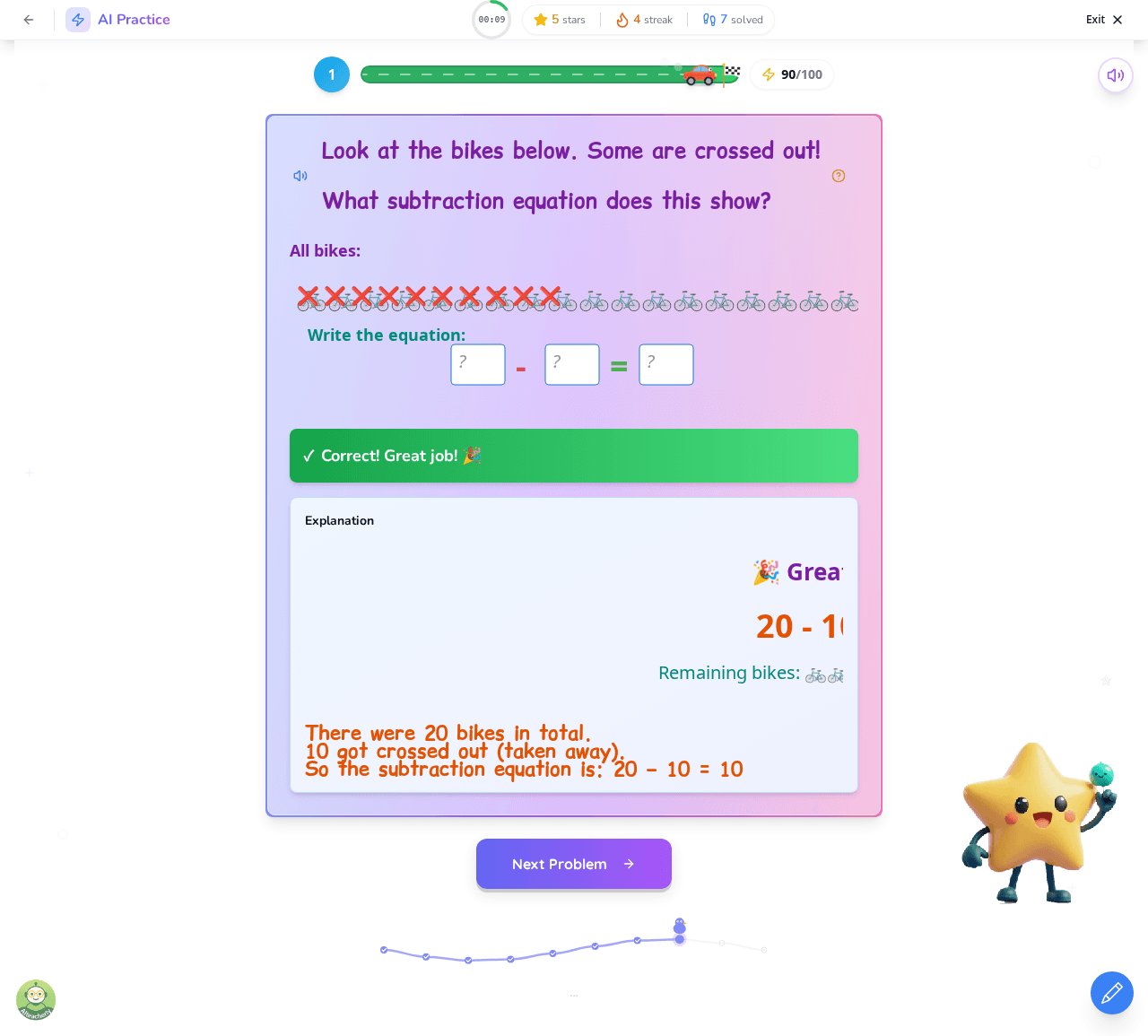
The interactive problem below shows exactly how this method looks in a digital learning environment, where students see colorful objects and practice crossing them out:
Pro tip: Practice for just 10-15 minutes at a time. Short, consistent sessions work better than long, frustrating ones.
See the Crossing Out Method in Action
Understanding a concept and seeing it in practice are two different things. Interactive digital lessons bring the crossing out method to life in ways that worksheets simply cannot match.
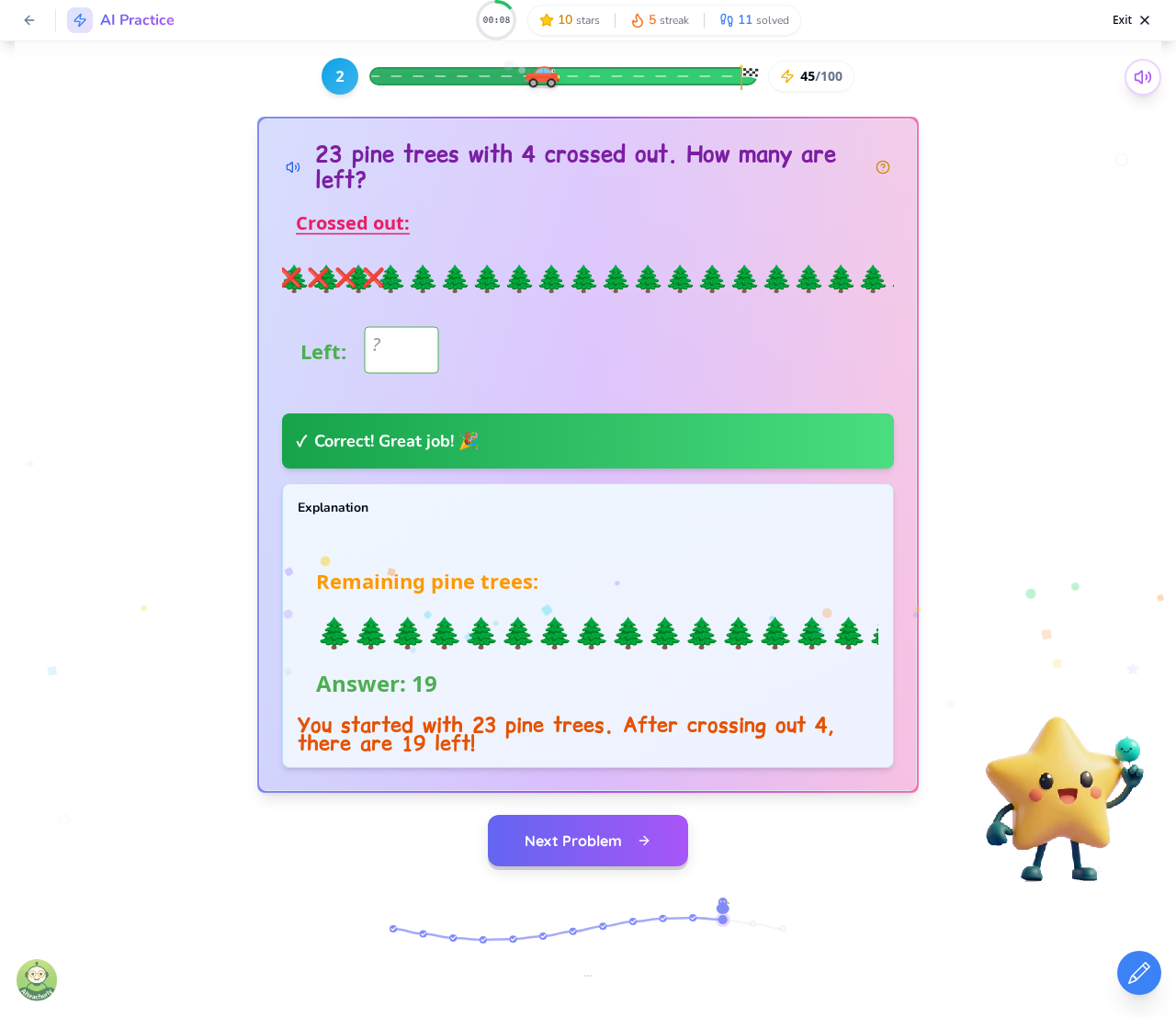
On AI Teacherly, the "Subtract by Crossing Out" lesson for Grade 2 guides students through the entire process with engaging visuals and immediate feedback. Students see colorful emoji objects on screen, cross them out interactively, and then connect what they see to the written subtraction equation.
Here's what the full interactive lesson looks like on AI Teacherly:
What makes interactive practice so effective?
- Instant feedback: Children know immediately if they're on the right track, preventing the reinforcement of mistakes
- Engaging visuals: Colorful emojis and objects capture attention better than black-and-white worksheets
- Self-paced learning: Kids can take their time without feeling rushed or judged
- Repetition without boredom: Multiple problem types keep practice fresh and interesting
- Progress tracking: Parents can see exactly how their child is improving
The lesson progresses from simple visual problems ("Cross out and count what's left") to more complex challenges ("Write the equation that matches the picture"). This scaffolded approach builds confidence as skills develop.
For parents looking to supplement homework or provide extra practice, interactive lessons like these offer a screen time option that's genuinely educational and engaging.
5 Everyday Objects Perfect for Subtraction Practice
You don't need fancy math manipulatives to practice visual subtraction at home. The best learning happens with familiar objects your child already loves. Here are five household items that work perfectly:
1. Snacks (Goldfish, Cheerios, Grapes) Food is incredibly motivating! "We have 9 goldfish. If you eat 4, how many are left?" Bonus: They get to eat their math work.
2. LEGO Bricks or Building Blocks Build a tower of 7 blocks. "If we take away 3, how tall is the tower now?" The physical removal makes subtraction tangible.
3. Stickers Put 8 stickers on paper. "Let's cross out 5 with a crayon. How many aren't crossed out?" This directly mimics the crossing out method.
4. Toy Cars or Action Figures Line up 10 toy cars. "4 cars drove away to the store. How many are still in the parking lot?" Story context makes math meaningful.
5. Coins (Pennies work great) Start with 6 pennies. "You spent 2 pennies on a pretend candy. How many pennies do you have now?" This introduces real-world money concepts too.
Practice Tips:
- Let your child choose which objects to use (ownership increases engagement)
- Keep numbers within 10 until your child shows consistent success
- Celebrate the process, not just correct answers ("I love how you counted carefully!")
- Make it playful; learning should feel like a game, not a chore
When Is Your Child Ready to Move Beyond Pictures?
A common parent concern is knowing when their child should stop relying on visual aids. The good news? There's no need to rush this transition. Children naturally progress from concrete to abstract thinking as their brains develop.
Signs your child is ready for mental subtraction:
- They solve visual problems quickly and accurately, barely needing to count the remaining objects
- They start predicting answers before finishing the crossing out
- They show frustration with "easy" visual problems and want more challenge
- They can explain WHY subtraction works, not just HOW to get answers
Signs they still need visual support:
- They make frequent counting errors when objects aren't visible
- They guess randomly instead of using a strategy
- They become anxious or shut down when asked to solve problems mentally
- They can get answers but can't explain their thinking
The gradual transition looks like this:
- Full visual: Objects or drawings for every problem
- Partial visual: Draw a quick number line or fingers instead of detailed pictures
- Mental with backup: Try mentally first, but use visuals to check
- Full mental: Confident solving without any visual aid
Most 2nd graders operate between stages 1 and 3. By the end of 3rd grade, many students transition to stage 4 for basic facts. Every child's timeline is different, and that's completely normal. The goal is understanding, not speed.
Key Takeaways
- Visual subtraction using the crossing out method builds genuine number sense, not just memorized answers
- 2nd graders learn best through concrete, hands-on experiences because of their developmental stage
- Practice the crossing out method at home using everyday objects like snacks, toys, and stickers
- Interactive digital lessons provide engaging practice with immediate feedback and progress tracking
- Visual strategies are not a crutch; they're a necessary foundation for mental math later
- Short, consistent practice sessions (10-15 minutes) work better than long, frustrating ones
- Let your child transition to mental math at their own pace; rushing causes anxiety and gaps in understanding
Frequently Asked Questions
What is the crossing out method for subtraction?
The crossing out method is a visual subtraction strategy where students draw objects, cross out the number being subtracted, and count what remains. It transforms abstract equations into concrete, hands-on learning that builds true number sense.
Why is visual subtraction important for 2nd graders?
At age 7, children's brains are wired for concrete thinking. Visual subtraction helps them understand WHY math works, not just memorize answers. This foundation prevents struggles with harder concepts like regrouping later.
Is it okay if my child still needs pictures to subtract?
Absolutely! Using visual aids is a normal developmental stage, not a weakness. Children naturally transition to mental math as their brains mature. Rushing this process creates anxiety and gaps in understanding.
How do I teach subtraction using the crossing out method at home?
Start with real objects (snacks, toys, coins), pose a simple problem, have your child physically remove items, count what's left, then connect it to the written equation. Practice 10-15 minutes at a time for best results.
What everyday objects work best for subtraction practice?
Snacks (goldfish, cheerios), LEGO bricks, stickers, toy cars, and coins all work great. Let your child choose which objects to use, as ownership increases engagement and makes practice feel like play.
When will my child be ready for mental subtraction?
Children are ready when they solve visual problems quickly, predict answers before finishing, and can explain WHY subtraction works. Most 2nd graders still benefit from visual support; the transition typically happens by end of 3rd grade.
How does the crossing out method help with harder subtraction later?
Students who truly understand subtraction through visual methods rarely struggle with regrouping (borrowing) in 3rd grade and beyond. The concrete foundation makes abstract concepts click naturally.
How long should my child practice subtraction each day?
For 2nd graders, 10-15 minutes of focused practice is ideal. Short, consistent sessions are more effective than long, frustrating ones. Make it playful and celebrate effort, not just correct answers.
Ready to make subtraction click for your 2nd grader? Try the interactive Crossing Out lesson free on AI Teacherly and watch your child's math confidence grow!